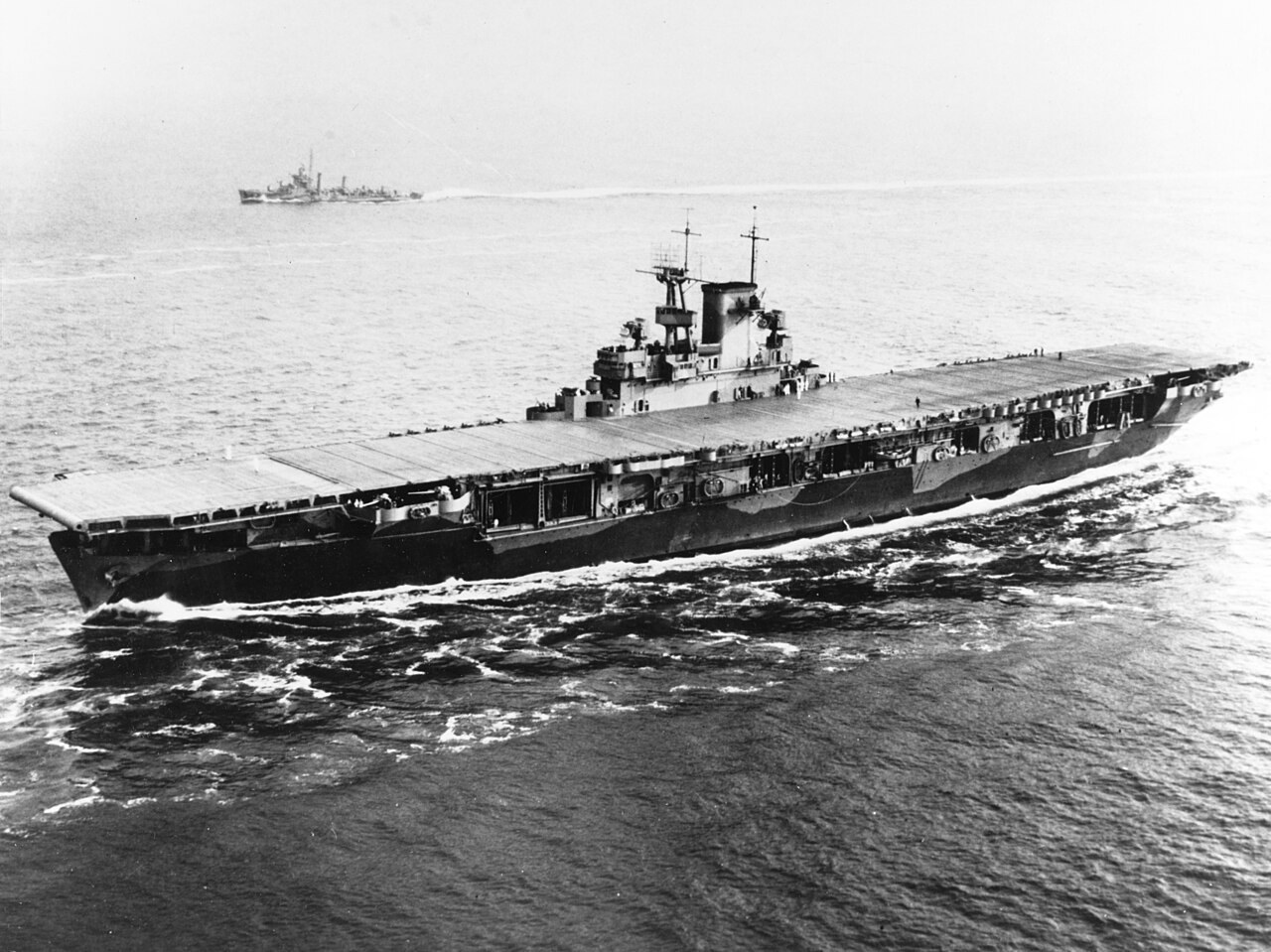
The Wasp that sank is USS Wasp (CV-7). She was a one-off carrier squeezed out of leftover treaty tonnage, fought in the Atlantic and at Guadalcanal, and was killed by the same torpedo spread that hit North Carolina.
Built to a leftover number
Washington Treaty carrier tonnage was almost used up by Yorktown and Enterprise. What remained was enough for a smaller ship. Keel laid at Fore River, Quincy, on 1 April 1936. Launched 4 April 1939. Commissioned 25 April 1940, Captain John W. Reeves Jr. in command. About 14,700 tons standard, 741 feet overall—shorter and tighter than a Yorktown, with the same job.
Atlantic first
Before Japan, she worked the Atlantic. In 1941 she ferried Army P-40s to Iceland so the occupation would have fighters. In spring 1942 she joined the British Home Fleet, then twice ran Spitfires into the Mediterranean for Malta—through Gibraltar in the dark, launch, turn around. Those two Malta lifts are why she has a European-African star.
In June 1942 the Pacific was down to three fleet carriers. She went west under Captain Forrest P. Sherman.
Guadalcanal
On 7 August 1942 her aircraft covered the landings on Guadalcanal and Tulagi. She stayed in the Solomons while the campaign ate ships. By mid-September she was escorting transports carrying the 7th Marines as reinforcements.
15 September 1942
At 1444 a lookout called three torpedoes, three points forward of the starboard beam. Japanese submarine I-19 had fired a spread of Type 95s. Wasp put the rudder hard over. Too late. Two, possibly three, hit in the gasoline tanks and magazines. One broached and struck above the waterline.
The forward part of the ship blew. Planes on deck were thrown hard enough to snap landing gear. Fire mains and power died. Damage control had no water and no lights. Sherman slowed, tried to put the wind so the fire would stay forward, then went astern. It did not hold.
The same spread continued past her. North Carolina took one and lived. Destroyer O’Brien took one and later broke up. It is often called the most effective submarine salvo of the war.
When the crew was off, Sherman left last. Destroyer Lansdowne scuttled her. She went down by the bow about 2100, south of San Cristobal, roughly 270 miles southeast of Guadalcanal. DANFS lists 25 officers and 150 men dead, plus International News Service correspondent Jack Singer. Other tallies run a little higher. About 1,900 men came off onto Helena, Salt Lake City, Laffey, Lansdowne, and Duncan.
Two battle stars. Struck 2 November 1942. The name went to Essex-class Wasp (CV-18), which finished the war.
Wreck
R/V Petrel found her on 14 January 2019 in the Coral Sea, about 4,200 meters down. Same expedition family that found Hornet a few weeks later. War grave. No salvage.
She was the small carrier built because the treaty still had a few thousand tons left. She kept Malta in fighters, covered the first American offensive in the Pacific, and lasted five weeks in the Solomons. After she went down, Hornet was the only U.S. fleet carrier left on that station—until Santa Cruz, six weeks later.