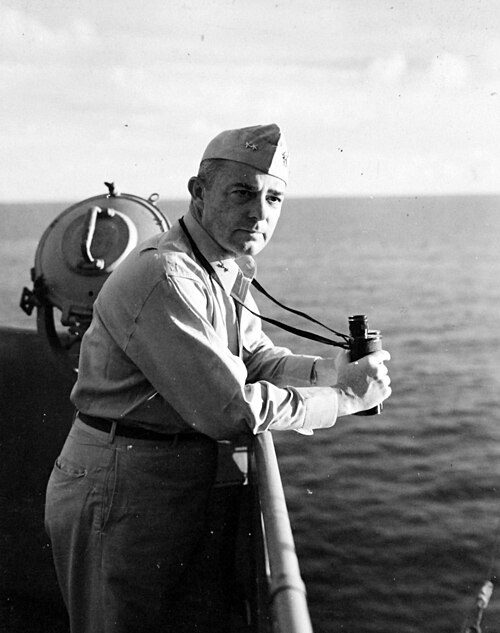
Aaron Stanton Merrill (26 March 1890 – 28 February 1961), called Tip, was the cruiser admiral of the Solomons. He commanded the first night action fought entirely by radar, and the battle off Empress Augusta Bay that covered the Bougainville landings. He retired a vice admiral. A Spruance-class destroyer carried his name.
Natchez to the Yangtze
He was born on 26 March 1890 at Brandon Hall, the family place near Natchez, Mississippi, the son of Dunbar S. Merrill and Charlotte B. Stanton. The nickname came from a great-grandfather who fought at Tippecanoe. He went to the Natchez Institute, entered the Naval Academy in 1908, and graduated with the class of 1912.
His first cruises were in the Mediterranean and the Black Sea. In the last months of the First World War he was in the destroyer Aylwin, based at Plymouth. In 1925 he commanded the gunboat Elcano on the Yangtze patrol. Two years in the Office of Naval Intelligence followed. In 1929 he took the destroyer Williamson. He made commander in 1932, went back to intelligence for a year, and then served as aide to the Assistant Secretary of the Navy.
One cruise stayed with him. He went to sea with the Chilean Navy and was the first foreign officer to round the Horn in a Chilean warship. Chile gave him the Order of Merit. He finished the senior course at the Naval War College in 1938–39 and was promoted to captain. In 1939–40 he commanded a destroyer division in the Pacific, with Somers as flagship. When the war came he was professor of naval science and tactics at Tulane.
Indiana, then the Slot
In April 1942 he became the first commanding officer of the new battleship Indiana. He made rear admiral in January 1943 and took Cruiser Division 12. His flag stayed in the light cruiser Montpelier for the whole Pacific tour.
His ships were at Rennell Island. When the heavy cruisers and their commander were pulled out for the Aleutians, he was left with the light cruisers and destroyers as Task Force 68, later 39. He ran the force the way a destroyer man would. After exercises he sat down with his captains. Arleigh Burke, his destroyer commander, talked him into letting the destroyers go in on their own the moment the enemy was sighted, fire torpedoes, and haul clear so the cruisers could shoot at long range by radar. That was the doctrine he took into the two fights that made his name.
Blackett Strait, 6 March 1943
On the night of 5–6 March he was on the way to shell the airfields at Munda and Vila-Stanmore. Radar picked up two ships in Kula Gulf, in the water called Blackett Strait. He turned the formation to intercept, identified them as Japanese, and opened fire on radar ranges alone, without a sighting. The destroyers Murasame and Minegumo were ablaze almost at once and sank. He then went on and bombarded both airfields. It was the first time an American admiral fought a night action with radar fire control and nothing else. He received the Legion of Merit. Some later accounts put this fight at the Battle of Kula Gulf. That was a different action, in July, under Walden Ainsworth. Merrill’s was Blackett Strait.
Empress Augusta Bay, 2 November 1943
The Bougainville landing went in at Empress Augusta Bay on 1 November. A Japanese cruiser-destroyer force came down to break it up. Merrill met it at 2:29 a.m. on the 2nd with four light cruisers, Montpelier, Cleveland, Columbia, and Denver, and eight destroyers.
The night was overcast. He used smoke to cover the turns and radar to lay the guns, and he let Burke’s destroyers attack on their own. In three hours the Japanese formation was turned. The light cruiser Sendai went down. The destroyer Hatsukaze, already dead in the water after colliding with the heavy cruiser Myoko, was finished. The rest, damaged, gave up the mission and retired. No American ship was lost. On the way out, carrier planes hit the force. The citation counts 67 attackers and 17 shot down. The same citation claims five Japanese warships destroyed, a cruiser and four destroyers. The ships actually sunk were Sendai and Hatsukaze. The Navy Cross followed, and in 1944 Forrestal authorized the Navy Unit Commendation for Cruiser Division 12.
Washington, New Orleans, Natchez
In June 1944 he came ashore as director of the Office of Public Relations. He then went with a mission to Chile on mutual defense. On 3 January 1946 he became commandant of the Eighth Naval District and commander of the Gulf Sea Frontier, at New Orleans, close to home. He was retired for physical disability on 1 November 1947 and advanced to vice admiral.
He had the Navy Cross, the Legion of Merit with a gold star, the Belgian Order of the Crown, and the Chilean Order of Merit, with campaign medals from Mexico through the Second World War. He left about 3,600 papers, mostly on his intelligence work. They are in the Wilson Library at the University of North Carolina.
He became president of Jefferson College at Washington, Mississippi, and was still in that post when he died on 28 February 1961. He is buried in Natchez City Cemetery. The escort destroyer Merrill (DE-392) was another man, an ensign killed in Arizona. The destroyer Merrill (DD-976), in service from 1976 to 1998, was his.