Ships
- USS North Carolina (BB-55) Captain, 15 June 1945 – 1 February 1946
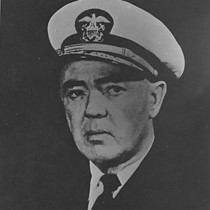
Byron Hall Hanlon was born in Rocklin, California, on 27 September 1899. He graduated from the United States Naval Academy with the Class of 1921 and spent his career in the regular Navy. He was promoted to lieutenant commander on 1 July 1936. From 16 June 1938 until April 1940 he commanded the destroyer Lamson.
The war moved him up quickly. He became a commander on 1 July 1941 and a temporary captain on 20 June 1942. From 11 November 1944 to 5 June 1945 he commanded the underwater demolition teams of the Amphibious Forces, United States Pacific Fleet, the swimmers who went in ahead of the landing force to examine beaches and clear obstacles. On 17 February 1945, in the pre-invasion assault at Iwo Jima, he took the demolition group and its supporting gunboats to within about a thousand yards of the shore. Japanese artillery and mortar fire sank one of the twelve gunboats and seriously damaged ten others. He received the Navy Cross for that action and the Legion of Merit with Combat V for the whole demolition command.
He came to the battleship North Carolina almost at once. On 15 June 1945 he relieved Oswald S. Colclough as captain. The ship had already served through the carrier raids and the island campaigns under Olaf M. Hustvedt, Oscar C. Badger, George H. Fort, Wilder D. Baker, Frank P. Thomas, and Frank George Fahrion. Hanlon’s tour was the last wartime command of that line.
He remained in North Carolina from 15 June 1945 to 1 February 1946. Those months covered the final weeks of the Pacific war, Japan’s surrender, and the ship’s passage into the reduced fleet of the peace. On 1 February 1946 he turned the battleship over to Timothy J. O'Brien.
Ordnance shore duty followed. From 1946 to 1948 he commanded the Naval Powder Factory at Indian Head, Maryland. In 1950 he briefly commanded the Naval Ordnance Laboratory at White Oak, Maryland, and from 1950 to 1952 he was superintendent of the Naval Gun Factory in Washington.
During the Korean War, as a rear admiral, he received an Army award of the Legion of Merit for service from 25 August 1952 to 26 February 1953, and the Army Distinguished Service Medal for service from 1 January 1953 to 23 April 1954. In 1956 he commanded Joint Task Force Seven and served as the senior representative of the Atomic Energy Commission at the Pacific Proving Ground for Operation Redwing, from 15 March to 21 July. That duty brought him the Navy Distinguished Service Medal.
He was promoted to vice admiral on 1 November 1957. He retired in October 1958 and, under the statute that advanced an officer one grade on retirement after a combat commendation, he left active service as an admiral. He died in Charleston, South Carolina, on 9 January 1977, after a long illness. His wife was Lady Brown Hanlon. Their son Kevin graduated from the Naval Academy in 1948, following Hanlon and Kevin’s maternal grandfather, Commodore Guy Warner Brown of the Class of 1879.