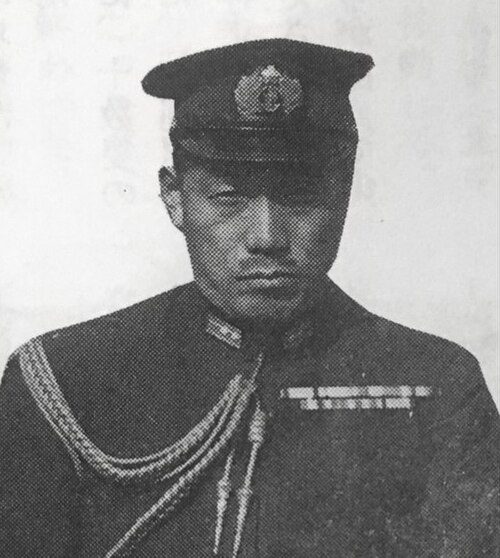
Ships
- IJN Fuso Captain from 5 December 1942 · Relieved on 1 June 1943
- IJN Musashi Captain from 9 June 1943 · Relieved on 6 December 1943
Keizo Komura was born on 20 July 1896 in Asahi, a village in the Kamiina district of Nagano Prefecture that is now part of Tatsuno. He went from Suwa Middle School to the Imperial Japanese Naval Academy at Etajima with the 45th class. Illness cost him a year, and he graduated in 1917 standing tenth among 89 cadets. Early sea duty took him to the cruiser Iwate and the battleships Settsu, Hizen, Suwo, and Nagato, with courses in gunnery and torpedoes. In 1929 he finished the Naval Staff College, was promoted to lieutenant commander, and commanded the destroyers Kuretake and Namikaze. He spent 1932 to 1934 in Britain, first as a resident officer and then as assistant naval attaché. Promoted to commander in November 1934, he taught at the Staff College, served on the staff of Destroyer Squadron 2, and commanded the 2nd Destroyer Division. He became a captain on 15 November 1938.
On 11 August 1941 he took command of the heavy cruiser Chikuma, which screened the carrier striking force with her sister Tone. Before dawn on 7 December 1941, Chikuma sent a floatplane ahead to look over Pearl Harbor. She stayed with the carriers through the early raids, the Indian Ocean operation in the spring of 1942, Midway in June, and the carrier battle off the Eastern Solomons in August. At Santa Cruz on 26 October 1942, dive bombers caught her in the vanguard. Hits and near misses flooded a boiler room, cut her speed, and wrecked the area around her torpedo tubes. Komura was wounded, with cuts on his face and neck and both eardrums ruptured, and he kept the deck until the cruiser was clear of the fight. Chikuma reached Japan with the damaged carriers in early November. He left her on 10 November 1942.
He became captain of the battleship Fuso on 5 December 1942, relieving Mitsuo Kinoshita. The old ship had lately been used to train midshipmen for the Etajima academy, and she was working back into fleet routine in the western Inland Sea. That December she exercised with the carrier Zuikaku and the battleships Musashi and Yamashiro. In January 1943 she was returned to the fleet from the academy. For the rest of his time in command she remained in home waters. On 1 June 1943, at Hashirajima, Nobumichi Tsuruoka relieved him. Komura left the anchorage on 8 June.
On 9 June 1943 he became the second captain of Musashi, relieving Rear Admiral Kaoru Arima. The ship put to sea at once and then entered Yokosuka. On 24 June the Emperor came aboard for a visit that ran from late morning into the afternoon. The imperial standard was hoisted. Admiral Mineichi Koga, commander in chief of the Combined Fleet, received him, and the Emperor walked through crew spaces and an antiaircraft station high on the bridge. Musashi went on to Kure, docked in the first week of July for hull work and a Type 22 radar on the bridge, and on 5 August arrived at Truk as Koga's flagship. In mid-September she stayed in the lagoon while other ships sortied toward Eniwetok. From 17 to 26 October she sailed with a large fleet to Eniwetok and then to a point about 250 miles south of Wake, made no contact with American carriers, and returned to Truk. Komura was promoted to rear admiral on 1 November 1943 while he still had the ship. He was relieved on 6 December 1943, and Bunji Asakura followed him in command.
That day he became chief of staff of the Third Fleet under Vice Admiral Jisaburo Ozawa. From 1 March 1944 he was also chief of staff of the First Mobile Fleet, the carrier force Ozawa led to sea. In the Battle of the Philippine Sea, on 19 and 20 June 1944, that force lost most of its aircraft, and submarines sank the carriers Taiho and Shokaku. Komura remained Ozawa's chief of staff until 1 October 1944, when a separate headquarters for the 1st Carrier Division was formed under him. The division's ships were the new carriers Unryu and Amagi, with Katsuragi joining in the middle of the month. Their air groups were not ready, and during the Battle of Leyte Gulf the division stayed in home waters. The carriers sent north as a decoy were sunk off Cape Engaño. In the same week the two battleships he had commanded were lost in the Philippines. Musashi, by then under Toshihira Inoguchi, went down under air attack in the Sibuyan Sea on 24 October 1944. Fuso, under Masami Ban, was lost in Surigao Strait in the night battle of 24–25 October.
He left the 1st Carrier Division on 10 December 1944 and, on 3 January 1945, took command of Destroyer Squadron 2. His flag flew in the light cruiser Yahagi, whose captain was Tameichi Hara. When the Navy ordered Operation Ten-Go, the one-way run against the American fleet off Okinawa, Komura argued that the men and the guns would count for more in the defense of the home islands. He then proposed sending Yamato and her escorts out as commerce raiders. The orders stood. On 6 April 1945 the force left Tokuyama: Yamato, Yahagi, and eight destroyers. Yamato was commanded by his Etajima classmate Kosaku Aruga. The next day, southwest of Kyushu, carrier planes put a torpedo into Yahagi's engine room and then sank her with more torpedoes and bombs. Komura ordered the crew off and stayed with Hara until the ship threw both of them into the water. From the sea he watched Yamato capsize and explode. The destroyer Hatsushimo picked him up, and the survivors were taken to Sasebo.
He left the squadron in April 1945 and in May became chief of staff of the Yokosuka Naval District, remaining there through the surrender. He then handled demobilization work in the Yokosuka area and left the service in June 1946. A provisional bar on public office was issued against him on 28 November 1947. He died on 7 February 1978, at 81, and was buried at Aoyama Cemetery. He was a large man, about six feet tall and around 220 pounds, and crews nicknamed him the officer who called for full speed on both engines. Before the Okinawa sortie he had spoken in English to the Japanese-American communications officers on Yahagi and told them to do what they could to stay alive.