Ships
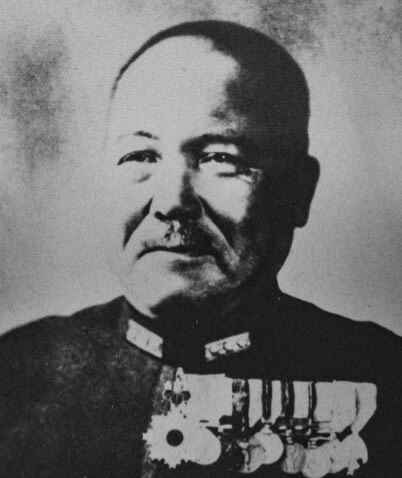
- IJN Myoko Flag, not her captain, 8 May 1942
Takeo Takagi was born on 25 January 1892 in what is now Iwaki, in Fukushima Prefecture. He graduated from the Imperial Japanese Naval Academy in July 1911, seventeenth in a class of 148, and made his name as a torpedo and submarine officer. After the Naval Staff College he commanded the submarines Ro-28 and Ro-68 in the mid-1920s, then served on the staff of a submarine squadron.
He reached captain in December 1932. In November 1933 he took the light cruiser Nagara. In December 1936 he moved to the heavy cruiser Takao, then wearing the flag of the Second Fleet, and in December 1937 to the battleship Mutsu while she was flagship of the Combined Fleet. Promoted to rear admiral in November 1938, he became chief of staff of the Second Fleet. From November 1939 he headed the Second Section of the Navy General Staff, the office concerned with mobilization and war plans.
In September 1941 he was given Cruiser Division 5: the heavy cruisers Myoko, Nachi, and Haguro. The division covered landings in the southern Philippines at the start of the Pacific War. On 4 January 1942, in Malalag Bay at Davao, American bombers hit Myoko. A bomb burst beside a turret, men were killed on deck, and the blast left Takagi lightly wounded. The division flag shifted to Nachi, and Myoko went to Sasebo for repair. In late February he directed the eastern covering force at the Battle of the Java Sea from Nachi. The night action on 27 February and the pursuit on 1 March scattered the Dutch, British, American, and Australian squadron and cleared the sea approach to Java. Officers at home still faulted him for keeping the daylight gun battle at very long range.
He was promoted to vice admiral on 1 May 1942 and ordered to command the carrier striking force for Operation Mo, the seaborne attempt on Port Moresby. On 8 May 1942, in the Battle of the Coral Sea, he flew his flag in the heavy cruiser Myoko. Her captain was Teijiro Yamazumi, who had commanded her since August 1941. Rear Admiral Chuichi Hara, a classmate from the academy, handled the carriers Shokaku and Zuikaku, with Myoko and Haguro in the screen. American aircraft damaged Shokaku. Japanese aircraft sank Lexington and damaged Yorktown. Myoko came through the day afloat and later steamed for home with the cruisers. The light carrier Shoho, operating with the invasion covering group, had already been lost on 7 May. With his air groups badly reduced, Takagi refused a further strike and drew the force north. The Port Moresby landing was called off. Combined Fleet headquarters pressed him to finish the American carriers, and the operation stood as a strategic failure even though the carrier exchange looked favorable on paper.
Teruhiko Miyoshi relieved Yamazumi in Myoko on 23 May 1942. Takagi stayed in command of the division. At Midway in June, Myoko and Haguro sailed in Vice Admiral Nobutake Kondo’s supporting force, clear of the carrier battle that destroyed the Japanese striking force. Through late summer and autumn the division worked in the Solomons. On the night of 15 October Myoko took part in the bombardment of Henderson Field on Guadalcanal, and the ships were out again for the carrier battle of the Santa Cruz Islands. In November 1942 Takagi left the division for shore command of the Mako Guard District in the Pescadores.
In April 1943 that command shifted to Takao, on Taiwan, and he went with it. In June he became commander in chief of the Sixth Fleet, the navy’s submarine force, and placed his headquarters on Saipan. The boats were spent largely on scouting and on direct support of fleet movements as the American offensive entered the central Pacific, and the losses ran high.
American troops landed on Saipan in June 1944, with the Sixth Fleet headquarters still on the island. Takagi was killed there in July 1944 as the garrison was overrun. He was fifty-two. Accounts of his last hours do not agree: one has him refusing a submarine evacuation and dying in a final attack ashore, and another leaves him missing after the battle. The navy advanced him to admiral after his death.