Ships
- USS Wasatch (AGC-9) Flag, not her captain, from 14 October 1944
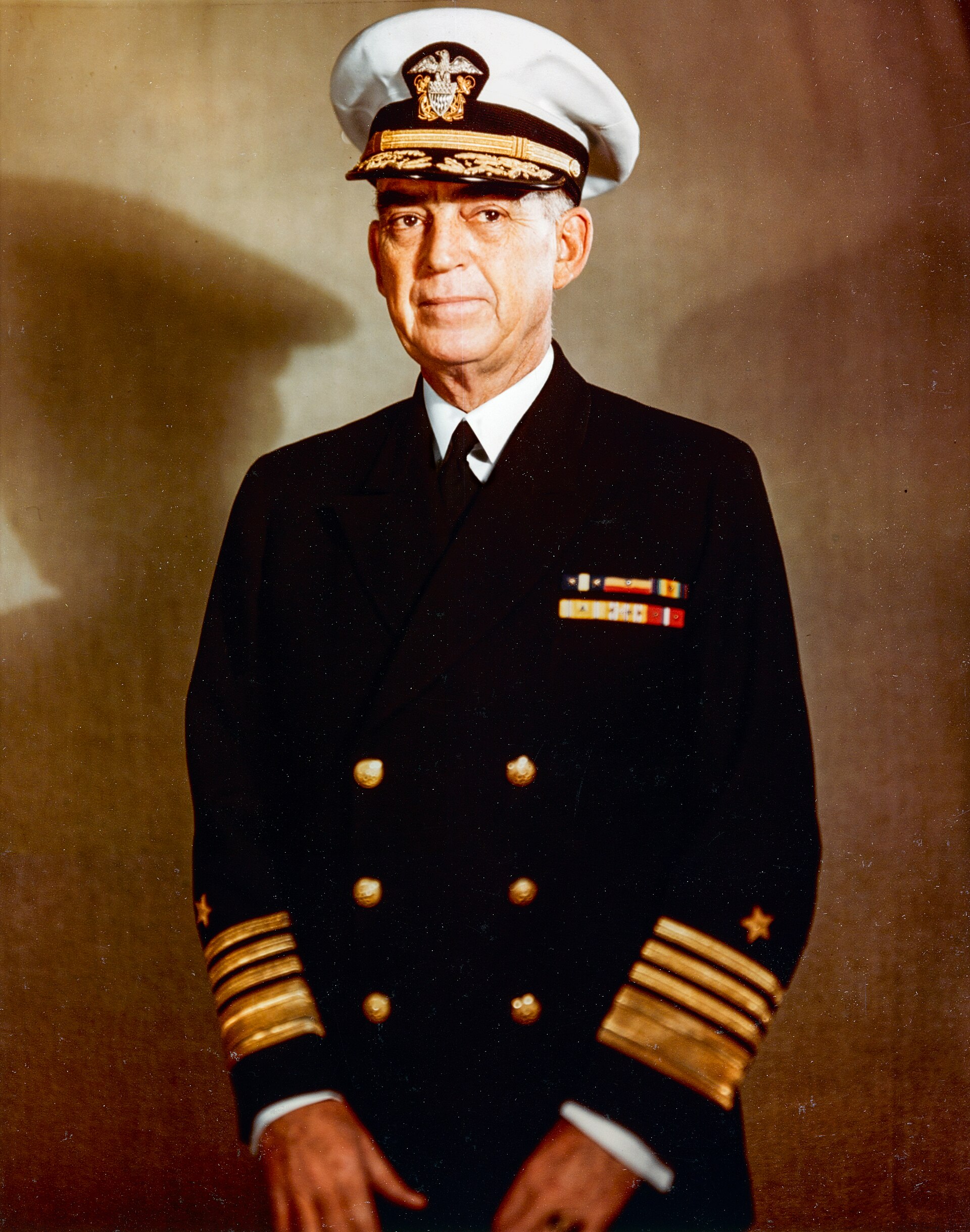
Thomas Cassin Kinkaid was born in Hanover, New Hampshire, on 3 April 1888. His father was a naval officer. Kinkaid graduated from the United States Naval Academy in June 1908, and his first ships were the battleships Nebraska and Minnesota. He trained in ordnance engineering, and in the First World War he served in the battleships Pennsylvania and Arizona. Between the wars he worked at the Naval Gun Factory, on fleet gunnery staff, and as a naval adviser at the Geneva disarmament conference of 1931-1932. He was executive officer of the battleship Colorado in 1933 and 1934, then ran the officers' detail section in the Bureau of Navigation until the middle of 1937.
As a captain he commanded the heavy cruiser Indianapolis. From 1938 to 1941 he was naval attaché in Italy, with added duty in Yugoslavia. He came home as the United States moved toward war and took command of a destroyer squadron. Late in 1941 he was promoted to rear admiral and given a cruiser division in the Pacific. In 1942 those cruisers screened carriers in the early fleet battles, with Lexington at the Coral Sea and Hornet at Midway. In the second half of the year he led a task force built around the carrier Enterprise in the fight for the southern Solomons, including the Battle of the Eastern Solomons and the Battle of the Santa Cruz Islands.
In January 1943 he took the North Pacific Force. He moved his headquarters forward to Adak and directed the operations that retook Attu in May and Kiska in August, the second island already emptied by the Japanese garrison. He was promoted to vice admiral in June 1943.
On 26 November 1943 he became commander of the Seventh Fleet and of the Allied naval forces in the Southwest Pacific, under General Douglas MacArthur. Through 1944 that fleet carried the army along the north coast of New Guinea and toward the Philippines. Its landing schedule ran from the Admiralty Islands and Hollandia on to Morotai, with cruisers, destroyers, and escort carriers covering each assault.
Vice Admiral Thomas C. Kinkaid commanded the Seventh Fleet at Leyte. On 14 October 1944 his flag went up in the amphibious command ship Wasatch (AGC-9). The ship kept her own commanding officer. Kinkaid was the fleet commander embarked, and he was not her captain. Lieutenant General Walter Krueger, who would put the Sixth Army ashore, was embarked for the landing. On 20 October Wasatch went up into Leyte Gulf and stayed off the beaches as the command ship while the troops landed.
On 24 and 25 October Kinkaid was still in Wasatch, in the gulf, as the battle spread around the anchorage. Rear Admiral Jesse B. Oldendorf's battle line met a Japanese force in Surigao Strait. Kinkaid was not in the strait with Oldendorf. Off Samar, Clifton Sprague's escort-carrier unit, Taffy 3, fought a Japanese surface force at close range. Kinkaid was not in that gunfight. He followed both actions by signal and directed the Seventh Fleet from the gulf. He left Wasatch at Humboldt Bay on 2 November 1944 and shifted his flag ashore.
He returned to Wasatch on 20 November 1944. In January 1945 he was on her bridge in Lingayen Gulf when the Luzon landing went in. The Seventh Fleet remained MacArthur's navy through the rest of the Philippine campaign and the Borneo landings. Kinkaid was promoted to admiral on 3 April 1945. When the war ended, ships under his command carried occupation forces to Korea and the China coast.
In 1946 he took the Eastern Sea Frontier and the Atlantic Reserve Fleet. He retired in 1950. From 1953 he served fifteen years with the American Battle Monuments Commission. He died on 17 November 1972. The destroyer Kinkaid (DD-965), commissioned in 1976, carries his name.