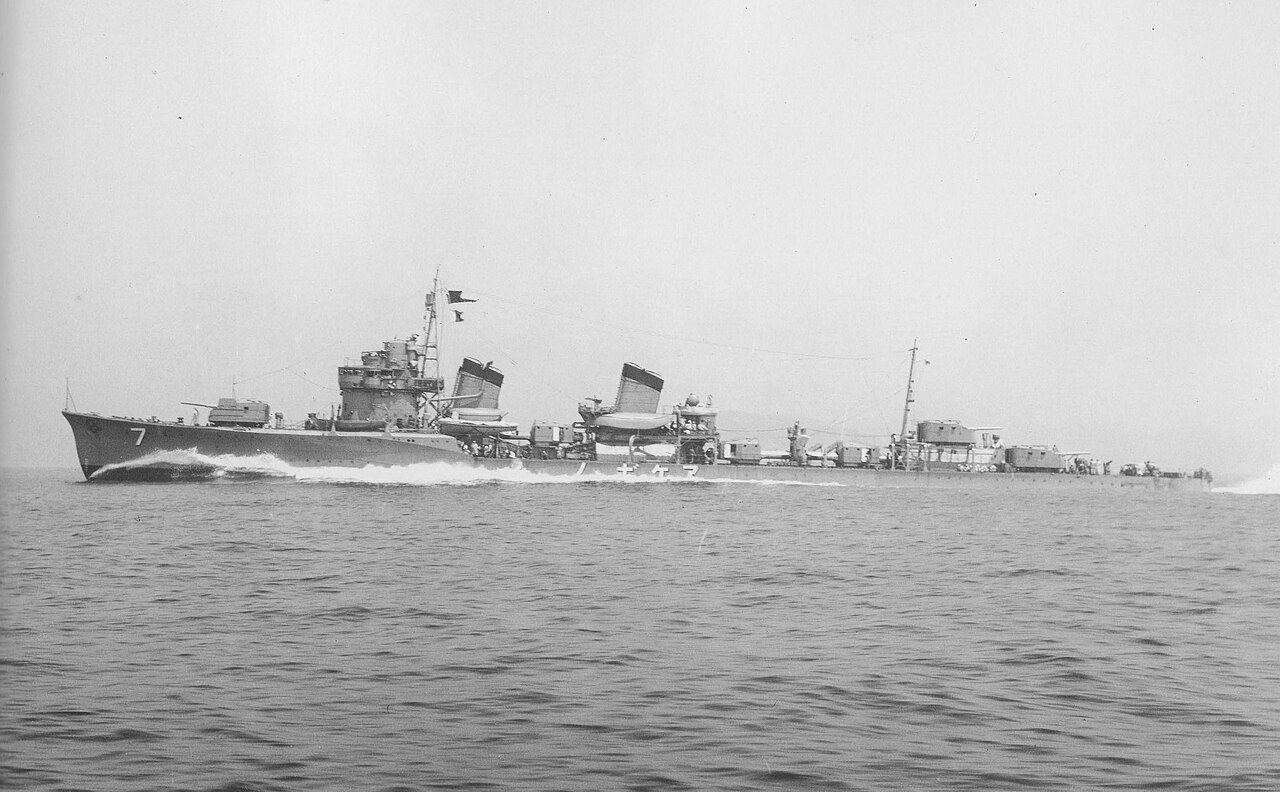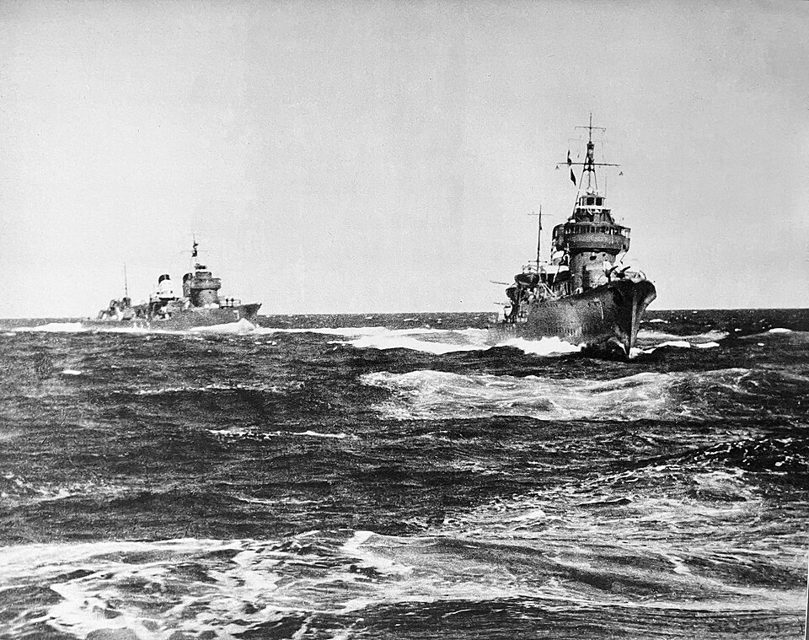
Akebono (曙) means daybreak. Fujinagata, in Osaka, laid her down on 25 October 1929, launched her on 7 November 1930, and commissioned her on 31 July 1931. She was a Fubuki-class destroyer, of the type the Navy called Special: six 5-inch guns in three twin mounts, and nine torpedo tubes. The 7 on her bow was Destroyer Division 7. Ushio sailed in that division with her. For most of the war the two of them were a pair.
She began the war under repair. A propeller had been damaged in training on 1 December 1941, and into the new year she stayed in home waters, guarding battleships and patrolling for submarines. In January she went south. On 1 March 1942 she was in the force that finished the cruiser Exeter and the destroyers Encounter and Pope. Those sinkings are not credited to one ship.
At the Coral Sea she screened Shokaku and Zuikaku, with Ushio. Shigure and Shiratsuyu were in that screen as well. Akebono was not hit. She was not with the carriers off Midway. She escorted the force that struck Dutch Harbor.
After that the work was escort. Carriers going south and coming home, then the northern cruisers Nachi and Ashigara between the home islands and the fleet. Ushio was usually in company. Akebono was docked, given more guns and a radar, and sent out again. In January 1944, after Sazanami was torpedoed, she took off eighty-nine of that ship's survivors.
On 24 and 25 October 1944 she was with Vice Admiral Kiyohide Shima's force, the column that followed Nishimura toward Surigao Strait. The strait itself was not her fight. The cruiser coming out of it was. Mogami came back on fire, after the American destroyers and the battle line had wrecked Nishimura's ships. Aircraft then left Mogami dead in the water. Akebono came alongside and took off about 700 men. She put one torpedo into the cruiser. Mogami sank at 13:07. Shigure was the only ship of Nishimura's own column still underway. Shiro Yoda had Akebono.
She reached Manila the next day. On 5 November, in an air raid on the harbor, she was badly hit while trying to help Nachi. Twenty-four of her men were killed. Ushio towed her into Cavite.
On 13 November 1944 American carrier aircraft sank her in Manila Bay. The sinking is not pinned to one plane. Her captain, Shiro Yoda, was among the men who got off.
She had come through the Coral Sea without a hit. The years after that were escort work. The afternoon alongside Mogami was the job that stayed with her name. Manila was the end of the ship.