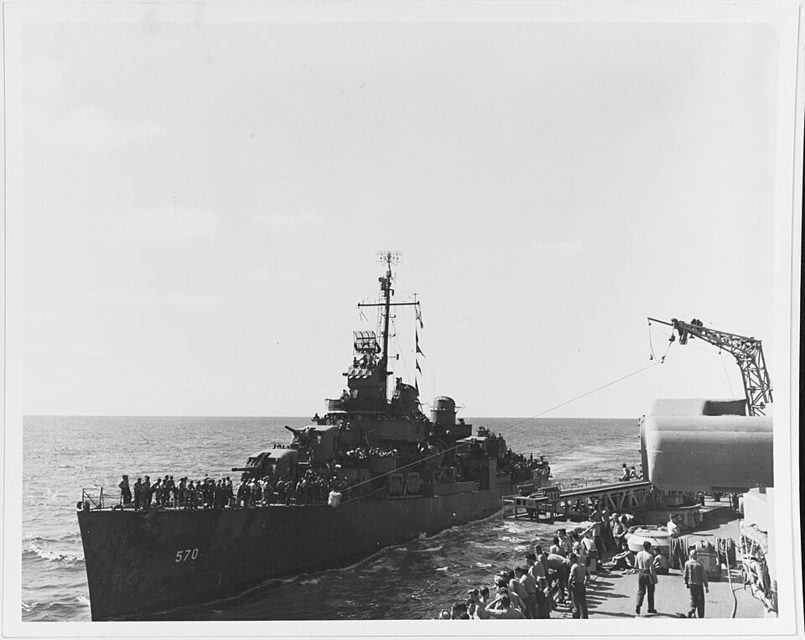
Charles Ausburne was named for Charles Lawrence Ausburne. On 17 October 1917 he was an electrician on the transport Antilles. A torpedo sank her. He stayed at the emergency wireless until the ship went under him, and he was awarded the Navy Cross after his death. An earlier destroyer had spelled the name Ausburn. This ship, DD-570, uses the spelling he signed. She was a Fletcher-class destroyer. Consolidated Steel at Orange laid her down on 14 May 1941, launched her on 16 March 1942, and commissioned her on 24 November 1942. Commander Luther K. Reynolds was her captain.
On the night of 1–2 November 1943 she was Captain Arleigh A. Burke's flagship off Empress Augusta Bay. Burke commanded Destroyer Squadron 23. She led the van, with Dyson, Stanly, and Claxton. Commander Bernard L. Austin had the rear division: Spence, Thatcher, Converse, and Foote. Merrill's flag was in the cruiser Montpelier, with Cleveland, Columbia, and Denver.
The cruisers sank Sendai. That fire is not credited to one ship. Myoko collided with Hatsukaze and cut off the destroyer's bow. American destroyers finished Hatsukaze. Claxton, Spence, Stanly, and Thatcher were in that fire. It is not credited to one of them, and Charles Ausburne is not the ship named for it. The usual account is that a torpedo from Sendai's spread wrecked the steering of Foote. Foote was not sunk. Charles Ausburne stood by her. She herself was not sunk.
The squadron received the Navy Unit Commendation for the Solomons campaign from 1 November 1943 to 23 February 1944. She was decommissioned on 18 April 1946 and transferred to West Germany on 12 April 1960.