Ships
- USS Foote (DD-511) Captain, 22 December 1942 – 30 April 1943
- USS Spence (DD-512) Division flag, not her captain, 2 November 1943
- USS Converse (DD-509) Division flag, not her captain, 25 November 1943
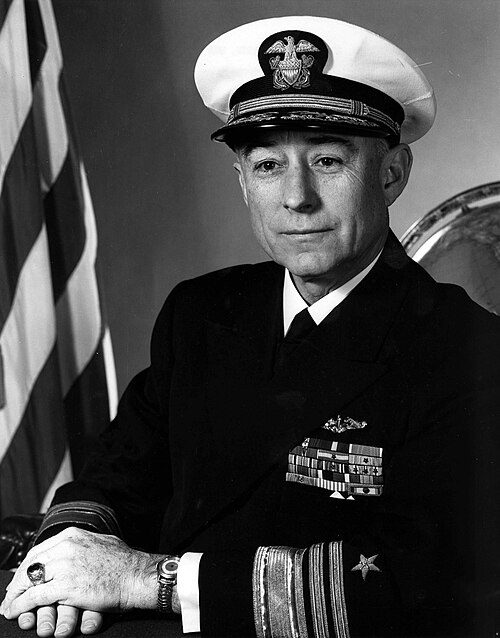
Bernard L. is the form the Navy still used in print in the middle of the war. The Register of Commissioned and Warrant Officers of 1 July 1944 indexes him as “Austin, Bernard L., Capt.,” file number 58722. The middle name is not an invention. The Naval Academy Lucky Bag for the class of 1924 heads his sketch “BERNARD LIGE AUSTIN.” The Hall of Valor transcriptions of his citations use “Bernard Lige Austin” and the same file number, written there as NSN 0-58722. He is the division commander in the rear of Rear Admiral A. Stanton Merrill’s Task Force 39 on the night of 2 November 1943.
The job, the date, and the four ships hold, and he was a commander that night. The Navy Cross citation for 1–2 November 1943 styles him “Captain [then Commander].” By the July 1944 register he was a captain. What has to be said before the night can be understood is that he was not the captain of any of those four destroyers. He had been Foote’s. The Dictionary of American Naval Fighting Ships entry for Foote, as carried on the ship’s Wikipedia page from the public-domain DANFS text, says she was commissioned at Bath on 22 December 1942 with Commander Bernard L. Austin in command, and that in April 1943 she received a new skipper, Commander Alston Ramsay. DANFS does not name a relief of Ramsay before the torpedo hit. On 2 November Austin was Commander, Destroyer Division 46, with his flag in Spence. Ramsay, if DANFS has the succession right, was the man on Foote’s bridge when the stern came off.
The usual account is what follows. Parts of it hold. Parts of it are in a fight among the sources, and the fight is the story.
Origins
The Lucky Bag gives his home as Greenwood, South Carolina. The Citadel Alumni Association, which lists him with the class of 1922, gives the hometown as Wagener and says he attended The Citadel for two years before graduating from the Naval Academy in 1924. He did not graduate from The Citadel. A Library of Congress finding aid for his papers, Bernard L. Austin: A Register of His Papers, is described in search snippets of the PDF as dating his birth 15 December 1902 at Wagener and his death 21 August 1979 at Bethesda. The PDF itself returned a 403 and was not read page by page, so those two dates are reported here as what the finding-aid text is said to contain, not as lines checked against the page. Later compilations, including the Hall of Valor and Wikipedia, move the death to 21 September 1979. That conflict is left open below. What is solid is the Academy.
He entered with the class that finished in June 1924. The yearbook sketch is the usual midshipman fiction, a made-up study hour in which a classmate called Jim borrows a solution and “Count” is late to formation and still makes it. The dialogue is not evidence of anything he said. The straight sentences at the end are yearbook prose, not a report: “Bernard’s unselfish nature has won for him many friends who expect success from this young idealist, who loves the navy and is ready to do more than his part.” The nickname is the part that lasted. Jack Sweetman, writing the battle in Naval History in 1995, calls him Commander Bernard L. (Count) Austin. Eugene Wolfe, in the same magazine in 1996, calls him Count. A son-in-law’s 2019 obituary still calls him Count. The column of activities printed near the sketch in the optical text of the Lucky Bag is scrambled by the two-column layout, and it is not used here. Expert rifleman, gym team, Lucky Bag staff: any of those may be his or his neighbor’s. They are not assigned.
Parents are a blank in the documents that were opened. Wikipedia, citing the same papers register, names Elijah Andrew Austin and Loula Ola Gantt. Find a Grave repeats the names. Neither was treated as proved.
The early sea career is in the same condition. The biographical sketch reproduced on his Wikipedia page is said there to be public-domain text from “Papers of Vice Admiral Bernard L. Austin, 1943–1967” at the Naval History and Heritage Command. That NHHC page returned 404 when it was asked for in 2026, so the sketch was not re-read at the source. What it says, and only as what it says, is a young officer’s ordinary climb: temporary duty under instruction in ordnance in the summer of 1924, two years in the battleship New York, torpedo school at Newport, the minesweeper Chewink at New London, then the submarines R-10 and R-6 out of Pearl Harbor, then three years back at Annapolis teaching physics and chemistry. The Library of Congress finding-aid snippet agrees that he taught physics and chemistry at the Academy in 1931–1934, and that his first command was the submarine R-11 in 1934–1937. The sketch sends him next to the presidential yacht Potomac as executive officer, and in December 1937 to the Navy Department as press-relations officer, a job it says he held until August 1940 and that he later thought had mattered to his making flag rank. The finding-aid snippet says the 1937–1940 period included Hanson Baldwin, the New York Times military correspondent. Speeches written for him by Secretary Charles Edison and Admiral Harold Stark, and articles on submarines for encyclopedias, are the sketch’s details. They were not found in a second source that could be opened.
In August 1940 the same sketch sends him to London as deputy to Rear Admiral Robert L. Ghormley, the Special Naval Observer, and says he was the only man besides Ghormley who sat in every meeting with the British political and naval leadership, Churchill included. The United States entered the war while he was still there. That London tour is the last of the pre-command life, and it is the part of him the later flag jobs resemble more than the night off Bougainville does: a staff officer in the room where other men decided, who had also had a submarine of his own and wanted a destroyer.
The war, as lived
The sketch says he took the destroyer Woolsey (DD-437) on 12 February 1942 and left her in December. DANFS for Woolsey, in the transcription on ibiblio, never names him. It does describe the ship’s work that year, and if the sketch’s dates are right he was her captain for it: Atlantic convoys to Iceland, the British Isles, and Puerto Rico, then Operation Torch. Woolsey sailed from Hampton Roads on 24 October 1942 in the screen of the Center Attack Group for Fedhala. On 16 November, still on antisubmarine patrol off the Moroccan coast, she, Swanson, and Quick depth-charged a U-boat. The ibiblio DANFS text says the boat was U-178 and that the attack “sent U-178 to oblivion.” The biographical sketch says the boat was U-173, and that for that day Austin received the Bronze Star with the Combat “V.” The hull number is a known sore point in the Woolsey history; it is not settled in this essay, because the action report was not read. The Bronze Star is in worse shape. The Hall of Valor’s list of his awards, which is long and specific, does not include it. A decoration that appears only in an unread NHHC sketch, and not in the award compilation that otherwise tracks his citations, is not stated here as a fact.
What can be said is smaller. He had come out of London and the submarines into a destroyer’s bridge in time for the first big American amphibious landing of the war, and the landing’s aftermath was a U-boat among the transports. Joseph Hewes went down on the 11th. Electra was torpedoed on the 16th. The three destroyers attacked. He was a lieutenant commander in August 1942, the sketch says, citing Morison, and a commander by Torch. Those rank steps were not re-checked in a 1942 register.
On 22 December 1942, the day DANFS gives for Foote’s commissioning, he was her first commanding officer. The ship was a new Fletcher, Bath-built, and he walked her out of the yard. How long he kept her is the April-versus-May problem. DANFS says Ramsay relieved him in April 1943, after which Foote escorted a convoy to Casablanca between 1 April and 9 May and reached Nouméa on 28 June to join Destroyer Squadron 23. The sketch says that in May 1943 he became Commander, Destroyer Division 46. Both can be true if he left the ship in April and hoisted the division pennant in May. Neither date was read from a deck log. Squadron 23, Captain Arleigh Burke’s squadron, was the one the Navy later called the Little Beavers. Division 45 was Burke’s own. Division 46 was Austin’s: Spence, Thatcher, Converse, and Foote.
Robert Marsh, in Naval History in December 2003, puts the blunt fact on the table and sources it to Theodore Roscoe’s U.S. Destroyer Operations in World War II, page 244. The four light cruisers and eight destroyers of Task Force 39 had never fought as a unit. Austin’s four destroyers were operating under his command for the first time and had no previous night action. He was not thoroughly familiar with Merrill’s tactics. That is the man who went into the battle. Not a stranger to command. A stranger to this formation, on the first night the formation existed.
DANFS for Thatcher gives the days just before the night, and they are his as division commander even though the entry is the ship’s. Task Force 39, Cruiser Division 12 and Destroyer Divisions 45 and 46, assembled at Purvis Bay and sortied on 30 October. On the night of 31 October–1 November the cruisers and destroyers bombarded the Buka-Bonis airfields, then ran south and shelled the airfields in the Shortlands, to keep Japanese aircraft off the Bougainville landing. The Silver Star citation, as transcribed by the Hall of Valor, covers 31 October to 2 November and says that under heavy fire from shore batteries he led his ships in “the initial bombardment of Buna-Bonis and the first daylight shelling of the Shortland Area.” “Buna-Bonis” is not a place in this operation. Buka-Bonis is. The citation text that was retrieved almost certainly mistranscribes Buka. The same citation then folds the night battle into the star and says the task force sank five enemy warships and damaged four. That number is the Navy’s, and it is not the battle’s. It is dealt with below, because the Navy Cross for the same night says it too.
The landing at Cape Torokina, on the shore of Empress Augusta Bay, went in on 1 November. Merrill’s job was to keep the Japanese surface force off the beachhead. He had four light cruisers, Montpelier, Cleveland, Columbia, and Denver, and eight destroyers, and he did not have another cruiser force in the South Pacific to replace them if he lost this one. Vincent O’Hara’s account, written from the action reports and from the Japanese side, has Merrill’s intention in one sentence: it would be enough to repulse the Japanese if he could avoid serious damage. The destroyers were to get their torpedoes off before the cruisers opened fire. Burke’s Division 45 was three miles ahead. Austin’s Division 46 was three thousand yards behind the rear cruiser. Vice Admiral Sentaro Omori was coming down from Rabaul with the heavy cruisers Myoko and Haguro, the light cruisers Sendai and Agano, and six destroyers, in three columns that two emergency turns had already disordered. Omori had left his transports behind. He expected to find ships in the bay. Merrill was across the mouth of it.
The American radar picked up Sendai’s column at 0227 on 2 November, a little over 35,000 yards by the Thatcher DANFS figure. At 0231 Burke hauled Division 45 out to port for a torpedo attack. At 0239 Austin’s destroyers and the cruisers countermarched, the rear becoming the van, so that Division 46 could bear southwest and shoot. The order went by TBS, voice radio. On Foote, the last ship, the countermarch was misunderstood. She fell out. O’Hara says she was still trying to catch the column at 34 knots when the torpedo hit her at 0301. DANFS says the hit blew off her stern, killed 19 men, and wounded 17, stopped both engines, took the steering, and left the main deck awash aft. The crew kept her afloat. She was towed into Purvis Bay on 4 November. She was not sunk. The usual account is that the torpedo was from Sendai’s spread. Marsh, citing Harry Gailey’s Bougainville, says Sendai’s salvo of eight, meant for the cruisers, missed them and hit Foote. O’Hara, working the Japanese times, thinks the fish was probably Samidare’s. The difference is which Japanese column. It is not a difference about what happened to the ship, or about whose formation she had fallen out of. She was Austin’s rear ship, and she was out of station because a signal in his division was missed, on a night when he was also, in Gailey’s account as used by Marsh, out of position himself. Marsh’s sentence, footnoted to Gailey page 82, is hard: Austin had misunderstood Merrill’s orders and was not in place to launch torpedoes until after the American cruisers had opened fire.
At 0311, by O’Hara’s timing, Spence and Thatcher sideswiped, heading opposite ways at about thirty knots, trying to avoid the cripple. DANFS for Thatcher is plainer about the hurt than Marsh, who calls the damage slight and leaves the sentence without a footnote. The collision sprung Thatcher’s starboard shaft and dished her starboard side amidships. She could still fight that night. She could not stay in the South Pacific. She went to Purvis, then Nouméa for the screw, then on 20 November sailed for San Francisco escorting Birmingham, and arrived on 14 December. Spence’s damage from the graze was less. The underwater hit was a different event. DANFS says that later in the action Spence took a hit below the waterline and salt water got into her fuel oil. O’Hara says Myoko found her at 0320, that the shell was a dud, and that the damage-control party plugged the hole with bags of beans. She was not sunk. The underwater hit is in the record, and so is the collision, which a short account leaves out. Both things happened to Austin’s flagship on the same night, and the collision was with the next ship in his own column.
The division’s torpedo attack, when it finally went in, did not hit. DANFS for Thatcher says Division 46 held fire until 0352 and then launched 19 torpedoes at two Japanese destroyers without scoring. O’Hara puts an earlier approach through the middle of the battle, eight torpedoes at the already wrecked Sendai of which two may have hit, then 19 more in a running fight that hit nothing, ranges closing to 3,000 yards and neither side scoring with guns. Sweetman adds a reason the first chance was missed that is worse than geometry: Austin’s combat-information-center officer became convinced the ships ahead were friendly, and the three destroyers still with him lost the shot at the enemy cruisers. That is one officer’s misidentification, inside Austin’s flagship, on a night when misidentification was the American disease. Burke’s division, an hour after its own torpedo attack, came back and fired on Austin’s ships. There are three versions of what was said on the radio, and they do not agree.
DANFS for Thatcher puts the words between the two ships that had just hit each other. Spence signaled Thatcher: “We’ve just had another close miss. Hope you are not shooting at us.” Thatcher answered: “Sorry. You will have to excuse the next four salvos. They’re already on their way.” DANFS then says Thatcher’s salvos missed Spence and sank Hatsukaze. O’Hara says Austin is “supposed to have” told Burke, “We have just had another bad close miss. Hope you are not shooting at us,” and that Burke answered that the next four salvos were already on the way. O’Hara does not give the line a source, and he does not give Hatsukaze to one destroyer. He says the two American destroyer groups together finished her with gunfire, and that the cruisers fired at her from 17,500 yards and missed. She sank at 0539. Marsh, footnoting the sentence to page 256 of Austin’s own Naval War College oral history, a typescript Marsh used and this essay did not, gives a third wording and puts it in Austin’s mouth to Burke: “For goodness sake, Arleigh, stop shooting at me.” Burke, in that version: “Okay, Count. I won’t shoot any more, but excuse the four salvos that are on the way.” The oral history was not read. The three versions are the record of a story that men kept because it was the night in one exchange: your own side, in the dark, shooting at you, and the salvos already gone.
Sendai was sunk, chiefly by the cruisers’ opening salvos, with the destroyers firing into what was left of her. Hatsukaze had already lost her bow to Myoko in a Japanese collision at 0307, and the fragment of that bow went back to Rabaul on the heavy cruiser. The American destroyers killed a ship the Japanese had already maimed. Shiratsuyu and Samidare were damaged and got away, in Sweetman’s account because of another mistaken identity between Burke’s ships and Austin’s. Haguro was hit lightly. Denver took three Japanese shells that failed to explode. No American ship was sunk. Foote was a wreck with nineteen dead. That is the battle. It is an American victory because Omori turned away and the transports at the beachhead were not touched. It is not the battle in the citation.
The Navy Cross, Commander, Southern Pacific Forces, serial 00162, 14 January 1944, as transcribed by the Hall of Valor, says that with his task force engaging a Japanese force of superior firepower, he “hurled the full fighting strength of his ships against the enemy and, by his inspiring leadership and skilled combat tactics, aided his Task Force in sinking five hostile warships, in damaging four others and in completely routing the enemy,” and so contributed to the beachhead on Bougainville. Five sunk and four damaged is not what the ships did. The Japanese losses that the battle accounts agree on are one light cruiser and one destroyer sunk, and a handful of ships damaged, several of them by their own collisions. The Silver Star citation uses the same five-and-four for the period that includes the bombardments and the battle. The citations are real. The arithmetic is the Navy writing a victory larger than the night. Marsh’s judgment, which is a historian’s and not a citation’s, is that the American destroyers were largely ineffective: Burke disappeared for an hour after his attack, and Austin wandered through the middle and hurt little except cripples. O’Hara is in the same place. The cross was awarded anyway, on 14 January, twelve days before the second one.
Three weeks later most of the division was gone. Foote was under repair. Thatcher was on her way to Mare Island or soon to be. What Austin still had, in Wolfe’s account of 25 November, was two ships. His flag was in Converse, Commander DeWitt C. E. Hamberger. Spence was under Lieutenant Commander H. J. Armstrong. Burke had Charles Ausburne, Claxton, and Dyson. The Japanese were running one more Tokyo Express: destroyer-transports Yugiri, Amagiri, and Uzuki taking aviation personnel off Buka back toward Rabaul, screened by Onami and Makinami. Burke had gone looking for them farther west than headquarters had suggested, up near Cape St. George, closer to Rabaul than Allied surface ships had been.
Wolfe’s article is a narrative by a man who had served under Burke in Mugford before this squadron existed. He was not at Cape St. George. The article does not show footnotes for the radio talk. The talk is used here as Wolfe’s version, not as a log. In that version Austin, who had heard Burke explain the new night tactics, came up on TBS while Burke was setting the first torpedo attack and asked to cross to the other side to cover him. Burke wanted the second division held back to strike after the first. He told Austin to stay where he was. Austin’s answer, in Wolfe, is the sentence that belongs to him more than any citation does: “Roger, but I’m being cut out of the show.” He stayed. Burke’s three ships put fifteen torpedoes into the screen. Onami blew apart. Makinami burned and stayed afloat. Burke went after the transports and told Austin to polish off the first target. Wolfe has Austin coming back on the circuit: “I’m going over to finish off what you didn’t finish.” Burke told him to stop cluttering the airways. Makinami took five torpedoes from Converse and Spence and was still there. One of her own torpedoes hit Converse and did not explode. Gunfire put her under at 0254. Yugiri was sunk later in the chase. Amagiri and Uzuki escaped up St. George Channel. Near 0400, with dawn and Rabaul’s aircraft ahead of them, Burke asked if anyone thought they could still catch the last ships. Austin said he did not think they could go much longer without fuel. Burke’s reply, in Wolfe, was that maybe they could refuel in Rabaul. They went home to the Treasuries. Thanksgiving Day broke over them under P-38s instead of Zeros.
The second Navy Cross is for that night, and the transcription is a mess that has to be read twice. The Hall of Valor action-date field says 24–25 November 1943. The citation body, Commander Southern Pacific serial 00193, 17 January 1944, says 24–25 November 1942. The year in the body is wrong. Cape St. George was 1943. The body also styles him “Commodore [then Captain]” in one place and the header “Commodore [then Captain],” while the first cross still had him a commander three weeks earlier. Temporary rank was moving fast, and the transcription is not a reliable witness to which rank he held on 25 November. What the citation claims is that he fought the division with “resolute courage and daring aggressiveness, frequently risking his own personal safety,” that the ships under him contributed to sinking four Japanese ships and seriously damaging two, and that he retired without loss or damage. The “without loss or damage” fits this night better than it would have fit 2 November. The four-and-two does not fit the fight the accounts give: three destroyers sunk, Onami, Makinami, and Yugiri, and two that got away. Home of Heroes conflates the two battles in one sentence, Cape St. George “during” Empress Augusta Bay. That conflation is an error. They were twenty-three nights apart, and they were not the same kind of night. On the first, his division was new, the signals failed, and Foote paid. On the second, he asked to be let into the attack, was told to wait, and then was told to finish the ship Burke had left burning.
The sketch says that in December 1943 he left Division 46 for Destroyer Squadron 14, with additional duty as commander of Destroyer Division 27. That relief was not read in a squadron war diary. If it is right, he was gone before the Presidential Unit Citation period for Squadron 23 ran out. The citation, the only one given to a destroyer squadron in the war, covers extraordinary heroism from 1 November 1943 to 23 February 1944. He was there for the first two battles of that span. Whether his name is on a personal authorization to wear the ribbon was not seen. The sketch says he was awarded the ribbon. It is left as the sketch’s statement.
The Legion of Merit citation is on firmer paper, because the Hall of Valor transcription gives the duty and the dates in the citation itself. From 9 June 1944 to 1 September 1945 he was Assistant Chief of Staff for Administration to Commander in Chief, U.S. Pacific Fleet and Pacific Ocean Areas, Admiral Chester W. Nimitz. The citation praises organization and administration through the Marianas, Iwo Jima, Okinawa, and the occupation of Japan. It does not describe a ship. The sketch says he had gone first, on 15 April 1944, to the staff of Commander, Destroyers, Pacific, as assistant chief of staff for operations and training, and only on 9 June to Nimitz. The April date is the sketch’s. The June date is the citation’s. The Naval War College’s official note on its past presidents says that after the Solomons he joined Nimitz’s staff and was the youngest flag officer in the Navy when he was spot-promoted to commodore. The same note dates his life 1902–1967, which cannot survive a 1979 obituary, so the “youngest” claim sits in a paragraph that also gets his death year wrong. The 1 July 1944 register still lists him as captain, not commodore. Commodore in that war was a temporary rank. Captain in the register is the permanent one. Both can be in the record at once. The day of the spot promotion was not found in a register line.
He was nineteen years out of the Academy before he had a major sea command in a battle, and then he had two of them in twenty-three days, and then the Navy took him off the bridge and put him at a desk in Pearl Harbor for the rest of the war. The Legion of Merit is the decoration for the desk. The two crosses and the star are for the twenty-three days, written up cleaner than the nights.
The cost
Foote’s nineteen dead are the cost with names the record does not give. This essay did not find a muster. DANFS gives the number, and the number is enough to keep the citation from being the whole story. They died in his division, in the ship he had commissioned and then left, because she was out of station in a formation he had never fought, on a signal his rear ship did not understand, and he was himself, on Gailey’s account, not where Merrill’s torpedo plan needed him. The Navy called the result skilled combat tactics and five ships sunk. The people who have read the reports call it a confused night in which the cruisers did the work that mattered and the destroyers, Austin’s included, mostly missed, collided, and shot at each other.
He did not get a wound out of it, or a lost ship of his own. Foote lived, was towed home, repaired, and fought again at Leyte, Mindoro, Lingayen, and Okinawa under other captains. Thatcher lived, went back to the fast carriers, and was nearly killed by a kamikaze at Okinawa in 1945, long after he had any claim on her. Spence lived through his two battles and was lost later, in the December 1944 typhoon, under another man. The cost to him that the papers show is not a body. It is the record of a first night that did not match the rank he was about to be given, and a second night on which the preserved sentence is a complaint that he was being left out. Wolfe’s “cut out of the show” may be too neat, and it may be Burke’s biographers’ neatness rather than the TBS log. It fits the only character note that repeats from 1924 to 1943 without being a decoration: he wanted the work, he was late or held back, and he hated being the one not in it.
The oral history at the Naval War College, which Marsh cites at page 256 for the friendly-fire exchange and which the archives list as a 1971 transcription, was not read. What he thought the first night had cost him, in his own late voice, is a blank in this essay on purpose.
After
The sketch’s postwar list is a staff officer’s itinerary, and it is not re-walked here ship by ship, because the NHHC page was down and the finding aid was not opened. The shape of it, where a citation or an official page confirms the sketch, is this.
On 25 October 1945 the sketch has him ordered to the Office of the Chief of Naval Operations, then as the Navy’s secretary of the State-War-Navy Coordinating Committee, then in the first class of the National War College. It sends him to London again, as a student at the Imperial Defence College, and in 1950 to sea in a way that was not a cruiser’s bridge: Commander, Service Squadron 1, and then, immediately after Korea opened, out to organize and command Service Squadron 3 in support of the Seventh Fleet. The Distinguished Service Medal for that tour is a real citation, not a sketch. It covers 10 July 1950 to 8 February 1951. The Hall of Valor header wrongly pastes onto it the serial number of the 1944 Empress Augusta Bay cross, “Commander, Southern Pacific Forces: Serial 00162 (January 14, 1944).” That header is a copy error. The body is Korea. It says his mobile logistics force kept stock levels up, delivered supplies, and kept repair ships available through the Inchon landing in September and the Wonsan landing in October, so the combatants could stay at sea. He was a captain in the citation’s styling. The work was oil, ammunition, and machine shops. It is the opposite of the night he had been decorated for, and it is the work the fleet actually cannot fight without. The citation’s language is the Navy’s. The fact that he was given the logistics command at the start of a war, and decorated for keeping other people’s ships running, is the fact.
The sketch then makes him a flag officer in the capital sense: assistant director and then director of the International Affairs Division under the Chief of Naval Operations, and the first Navy member of the National Security Council staff; commander of Cruiser Division 2; the staff at SHAPE; on 15 March 1956, vice admiral and Director of the Joint Staff until 31 March 1958; from May 1958, the Second Fleet and, with it, the Atlantic Strike Fleet; from March 1959, Deputy Chief of Naval Operations for Plans and Policy. Those commands were not re-verified one by one. The Second Fleet and the War College are. The Citadel alumni note names the Second Fleet. The War College’s own page, and the second Distinguished Service Medal, name the college.
He became the thirty-second president of the Naval War College on 30 June 1960 and left on 31 July 1964. The college says the four years were the longest presidency to that date. The DSM for the tour says he pushed the teaching of maritime strategy against national and allied strategy, sat in on the instruction himself, started an annual meeting of the heads of the American service war colleges, and had a hand in conferences of the war-college presidents of the Americas. The sketch adds that he was a principal in creating the Naval Command College for senior foreign officers, and that in 1963 he presided over the court of inquiry into the loss of the submarine Thresher. The inquiry is the sketch’s. The report was not read. A man who had commanded an R-boat in the 1930s, and who had spent the interval becoming a destroyer commander and then a staff admiral, was the officer the Navy sat at the head of the table when a nuclear submarine went to the bottom off New England. That is the only Thresher sentence this essay will carry.
He was retired as a vice admiral on 1 August 1964, the sketch says, and retained on active duty as chairman of the Inter-American Defense Board. The third Distinguished Service Medal covers that chairmanship from August 1964 to June 1967: twenty republics, a board he is praised for pulling toward a common defense policy. The sketch says he was released from active duty on 17 October 1967. It also says he was called back in June 1968, and again that November, to preside over the board of inquiry into the loss of Scorpion, and that he went back to retirement on 14 December 1968. Two lost submarines, the gavel at two inquiries, six years apart, the second of them after he had already retired. If the sketch is right, the last work the Navy asked of him was to decide what could be said about men who did not come up. The inquiry report was not read, and the sketch is the only source opened for those dates.
The family that can be documented from a page that was actually read is one daughter. The 2019 obituary of Captain Nathaniel Willis James III, in the PenBay Pilot, says James met Alexandra “Alix” Austin at the Naval War College in Newport, that she was the daughter of Isabella Leith and Vice Admiral Bernard “Count” Lige Austin, and that they were married in the Naval Academy chapel on 8 September 1951. They had six children. Alix died before her husband. Wikipedia, again citing the papers register, says the marriage to Isabella Murray Leith was in 1925 and that there were two more daughters, Jane and Leith, and that Isabella died on 20 May 1983. Those two daughters and the wedding year were not found in a document opened for this essay. Find a Grave says he is buried with his wife in the Naval Academy Cemetery, section 3, lot 328. That is a user-maintained memorial. A cemetery register was not retrieved.
The death is the sharpest conflict in the file. The Library of Congress finding aid, in the snippet, says 21 August 1979, Bethesda. A Washington Post archive URL dated 24 August 1979 carries the headline “Vice Adm. B. L. Austin, Navy Cross Winner, Dies.” The article body would not load, so the headline and the URL date are all that was seen. A story filed on 24 August cannot be the obituary of a man who died on 21 September. The Hall of Valor, Wikipedia, TracesOfWar, and Find a Grave all say 21 September 1979, Bethesda, aged 76. The Naval War College page says he died in 1967, which is the year the sketch ends his last active-duty tour, not a death. Between August and September 1979, the August date is the one that can sit in the same month as a Post story. It is still a date from a PDF that was not opened, plus a headline that was not read through. No cause of death is stated here. Search-engine summaries offered a heart attack and cancer. Those sentences were not in any page this essay retrieved, and they are rejected.
What he left, on the evidence that was opened, was the two crosses, the star, three Distinguished Service Medals, the Legion of Merit, a daughter who married a Naval Academy man in the Academy chapel, and a nickname from a yearbook that officers were still using when they wrote the battles down. The Navy left him the War College for four years and then the two submarine inquiries. The beachhead at Empress Augusta Bay held. Foote’s dead stayed dead. The citation kept the five ships.