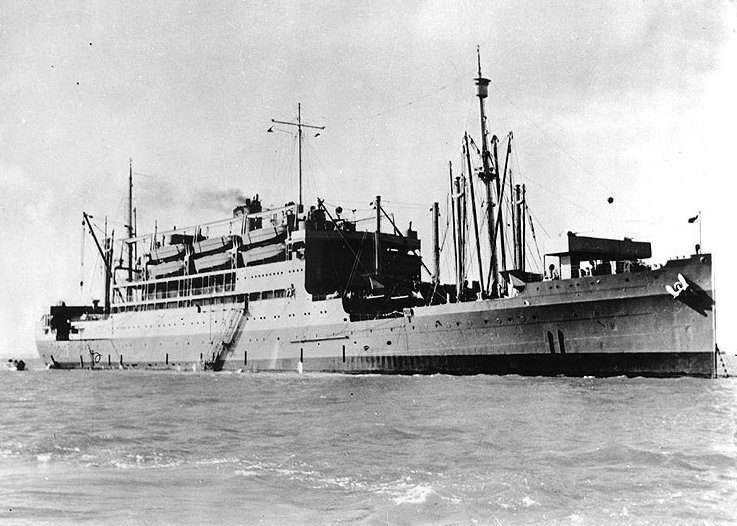
USS McCawley (AP-10) was named for Colonel Charles G. McCawley, commandant of the Marine Corps from 1876 to 1891. She was the second ship of the name. She had been the Grace Line steamer Santa Barbara, completed in 1928 by Furness Shipbuilding at Haverton Hill-on-Tees. The Navy took her from Grace Lines on 26 July 1940, renamed her on 29 July, and commissioned her on 11 September 1940. Captain Harry D. McHenry had her. She was a passenger liner fitted to put troops ashore, about 9,600 tons and 486 feet 6 inches long, with a crew of about 304. Her sister was Barnett (AP-11).
McHenry turned her over to Captain Charlie P. McFeaters on 7 January 1941. On 19 February 1942 she sailed for Iceland with troops on board and was back in New York on 25 March. She went down to Norfolk, passed the Panama Canal on 18 April, and on 8 May landed Marine aviators at Pago Pago. From there she went to Wellington and joined the Amphibious Force, South Pacific.
Shortly before the Guadalcanal landings she became the flagship of Rear Admiral Richmond K. Turner. He was not her captain. On 7 August 1942 she lay in Transport Division B off Beach Red, with Barnett, George F. Elliott (AP-13), and Libra. Marines went ashore at Tulagi at 0800 and at Lunga Point at 0919. Air attacks came the next day. Her guns were credited with three aircraft, and with a possible fourth. That evening Turner met Major General Alexander A. Vandegrift and Rear Admiral Victor Crutchley of the Royal Navy aboard her. The carriers were leaving sooner than had been planned, and the question was how long the transports and the screen could stay. On the night of 8-9 August she was still in the anchorage. The crew saw the flares off Savo Island. Canberra, Astoria, Vincennes, and Quincy were lost, and Chicago (CA-29) was badly damaged. Mikawa's column did not reach the transports. The ships kept unloading, and that afternoon they sailed for Noumea.
She was back at Guadalcanal on 18 September with supplies and reinforcements, and she left the same day with wounded men and prisoners. On 15 September, while the carrier covering that movement was still at sea, the submarine I-19 sank Wasp (CV-7). The same spread hit North Carolina, and O'Brien (DD-415) took one and later broke up.
On 9 October she sailed again, in a convoy carrying more than 2,800 reinforcements. Rear Admiral Norman Scott's cruisers covered the movement. On the night of 11-12 October those cruisers fought off Cape Esperance. She was not in that night action. She landed her troops and cargo and went back to Noumea with wounded men and prisoners.
On 8 November she left Noumea with other ships of Task Force 67. Rear Admiral Daniel J. Callaghan had two cruisers and three destroyers in support. Another convoy left Espiritu Santo under Scott. Her group reached Lunga Point on 12 November. About 1415 her guns set a torpedo plane afire after it dropped its torpedo off her starboard side. The burning plane struck the after control station of San Francisco (CA-38) and went into the water. Men at that station were killed. By dusk about nine-tenths of the transports' cargo was ashore. A strong Japanese force was reported on the way. At 1815 she left with the other transports and their destroyer screen, east through Lengo Channel into Indispensable Strait, and then on toward Espiritu Santo. Vice Admiral Hiroaki Abe was coming with Hiei, Kirishima, the light cruiser Nagara, and eleven destroyers to shell Henderson Field, ahead of Tanaka's reinforcement convoy. Turner left Callaghan and Scott, with the cruisers and destroyers, to meet that force. The firing began after midnight. She was already to the east, and she was not in that fight. Both admirals were killed. The reinforcement convoy was still far to the northwest. Aircraft destroyed most of those ships on the 14th. She reached Espiritu Santo on 15 November. During the battleship action off Savo on the night of 14-15 November she was on that passage.
On 24 November Robert Henry Rodgers relieved McFeaters, and she left Noumea for an overhaul at Wellington. She was back at New Caledonia on 10 January 1943 with the 1st Marine Raiders and the 3d Parachute Battalion. After they went ashore she loaded Army troops and construction gear and returned to the Guadalcanal run. On 1 February 1943 she was redesignated APA-4. Those supply runs lasted into the middle of June.
Turner used her again as flagship for the Rendova landing on 30 June 1943, the opening of the move into New Georgia. He was still not her captain. At 0543 she began unloading. Twice the work stopped for air attacks that never arrived. Unloading finished at 1350. As the column entered Blanche Channel, torpedo planes attacked. Her guns were credited with four of them. One torpedo hit the engine room, killed fifteen of the crew, and took all the power. Turner and his staff shifted to Farenholt (DD-491). Rear Admiral Wilkinson stayed to run the salvage. Libra took her in tow. Ralph Talbot (DD-390) and McCalla (DD-488) stood by.
Lieutenant Commander Cyril B. Hamblett of the Naval Reserve, her executive officer from August 1942 through June 1943, supervised getting the men off after the engine-room hit and received the Silver Star for the Guadalcanal and Tulagi landings, the supply runs, and that evacuation.
At 1640 Ralph Talbot took off everyone but the salvage party. Dive bombers then strafed her. The men still aboard manned the guns and were credited with one of three planes shot down. That pass added no further damage. By 1850 the draft aft was 38 feet. Wilkinson ordered McCalla alongside. Within the hour the salvage party was off the ship.
At 2023 she was torpedoed again and sank in about thirty seconds, in 340 fathoms. The next day the Navy learned that six American motor torpedo boats had fired at a ship they took for an enemy transport in Blanche Channel. They had been told no friendly ships were there. The crew was already off. The loss belongs to those six boats together and is not credited to one of them. The boats were then put under Turner, with a liaison officer on his staff. She received five battle stars. The day she was struck from the Naval Register is not known.