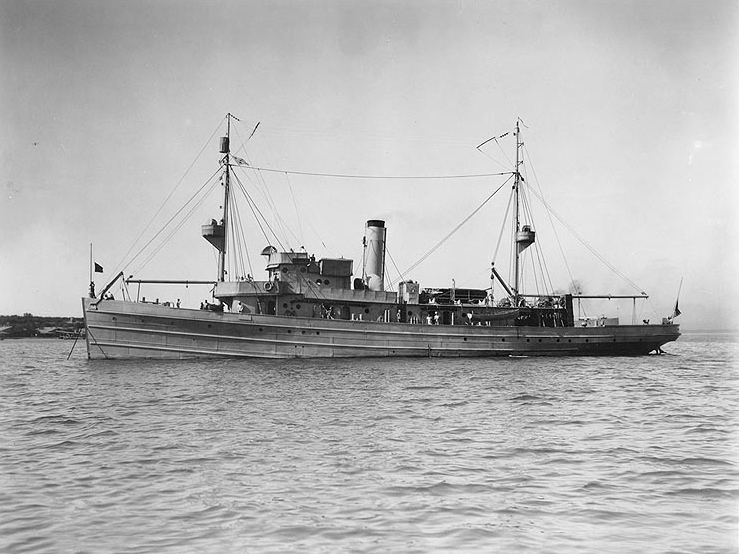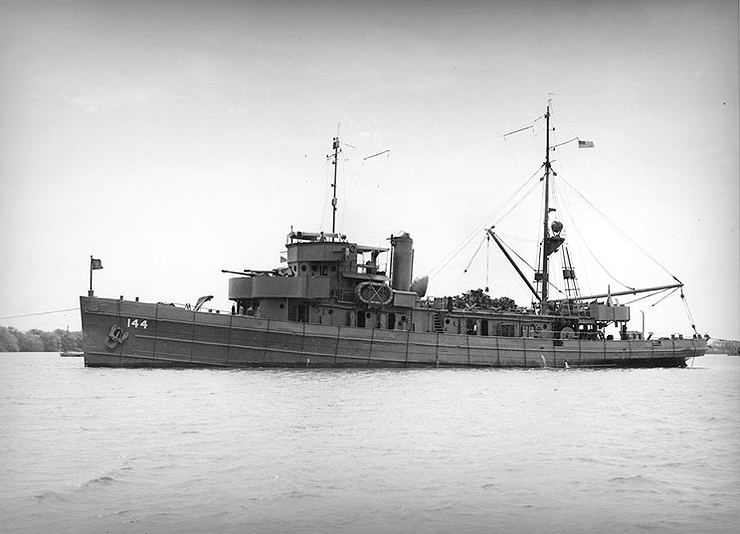
Vireo, Minesweeper No. 52, was a Lapwing-class minesweeper, named for the bird. DANFS gives her 840 tons, a length of 187 feet 10 inches, a beam of 35 feet 5 inches, a draft of 8 feet 10 inches, a complement of 186, and two 3-inch guns. The Philadelphia Navy Yard laid her down on 20 November 1918. She was launched on 26 May 1919, sponsored by Mrs. E. S. Robert, and commissioned on 16 October 1919 with Lieutenant Ernest R. Piercey in command. DANFS says she was reclassified AM-52 on 17 July 1920. The printed word in that sentence is reclassifled.
She joined the Train, Atlantic Fleet, and worked the east coast until 8 January 1920, when she left Norfolk for the fleet's winter maneuvers off Cuba. She was back at Norfolk on 28 April. Through 1932 she towed targets, carried men, mail, and material, repaired buoys and beacons, and operated with the Atlantic and Scouting Fleets. In July 1921 she towed several former German warships to sea off the Virginia capes, where aircraft sank them in the bombing tests. From December 1930 to March 1931 she was plane guard for the aircraft supporting the Nicaraguan-Puerto Rican aerial survey. Late in 1931 she was ordered to the Pacific Fleet Train. She left Norfolk on 2 January 1932, went by Guantanamo and the Panama Canal, and reached San Pedro on 6 March. She ranged from the California coast to Panama and Hawaii. On 10 November 1940 she left San Francisco for Pearl Harbor. From there she towed target rafts, swept for exercise, and towed to the outlying islands, including Palmyra and Johnston. From 5 September to 7 October 1941 she was overhauled at the Mare Island Navy Yard, then went west again. Lieutenant Commander Frederick Joseph Ilsemann had her from 31 January 1940.
On 7 December 1941 she was the inboard ship at the seaward end of the Coal Dock, bow to seaward, with Turkey, Bobolink, and Rail moored outboard. She was in upkeep. Ilsemann's report, as printed, is headed 10 December 1945. The text answers a December 1941 dispatch and reports the air raid of 7 December 1941. A second letter from the same ship is dated 25 December 1941. The 1945 date is left as the first sheet prints it. About 0755 she was still at the dock. About 0800 an explosion was heard. Planes with Japanese insignia were seen, and general quarters was sounded. About 0815 a second group flew over toward Hickam Field. She opened fire and expended 22 rounds of 3-inch antiaircraft ammunition and 400 rounds of .30 caliber. The report says her battery was two .30 caliber machine guns and two 3-inch/50 antiaircraft guns. It says that about 0830 she brought down one enemy plane flying forward of the bow, toward seaward, over Hickam Field, from left to right, and that the bursts of her number 2 antiaircraft gun were spotted in the path of that plane, which was seen to land in the vicinity of Hickam Field. That is her claim. Turkey's report of the same morning says no one vessel could claim a plane, because all four minesweepers were firing. The two reports are not reconciled here.
She was not damaged, and no one was killed. At 0830 Radioman Second Class Aubrey Evan Price, on watch at the telephone on the dock astern of her, was wounded by shrapnel in the jaw and neck. He was taken to the hospital at Pearl Harbor and returned to duty the same day. The engines were put together and she was made ready to get underway. She did not sortie. Her additional report of 25 December says the three ships alongside sortied about 0930. At 1348 she was ordered underway to report to the Commander, Base Force, at Ten-Ten Dock, and was sent to West Loch for 5-inch, 3-inch, and .50 caliber ammunition for California. At 1455, while she waited at the Naval Ammunition Depot, she hauled an ammunition lighter loaded with 14-inch powder away from the depot dock, where it was a menace, and moored it alongside the old Navajo. She then picked up the ammunition and delivered it to Argonne at 1730. At 2100 she moored alongside California and began salvage work. About 2110 antiaircraft fire opened, a plane was seen shot down, and an aviator fell astern. Vireo picked him up. He was an Enterprise aviator. A dispatch was sent to say that the planes then in the air were Enterprise planes. The aviator was transferred to California and then to the hospital. The report does not give his name. The additional report, signed F. J. Islemann on the printed page and F. J. Ilsemann on the first letter, says that about 0757 three dive bombers pulled out near West Loch, that about 0805 a torpedo plane was seen to fall in flames at the hospital, that about 0910 a plane flying low toward West Loch was fired on with the .30 caliber guns, and that a dive bomber crossed the ship at 500 feet, throwing off heavy smoke, and was not seen to land. About 0950 six horizontal bombers at about 8,000 feet flew up the channel and apparently dropped bombs on a berth in the Navy Yard. About 0930 a dive-bomber formation flying up the channel toward West Loch was apparently attacking destroyers that were sortieing. Three bombs landed in the channel and several landed on shore at the northwest entrance to West Loch. The report says the times, altitudes, and types are estimates.
After the attack she swept in the Pearl Harbor channel and other Hawaiian waters, and she was in upkeep at Pearl Harbor from 10 to 13 February 1942. She made short runs to Johnston Island and Hilo. In April and May she patrolled out of Hilo, sometimes with Crossbill (AMc-9), sweeping magnetically, acoustically, and mechanically, and listening. From 23 to 24 April, with Crossbill and Sacramento (PG-19), she searched for survivors of a downed Army plane off Pepeekeo Point, near Hilo, and found one body. On 28 May, under secret orders, she and the gasoline tanker Kaloli (AOG-13) left Honolulu for Midway. On 1 June 1942, during that passage, she was reclassified as an ocean-going tug, AT-144. They entered Midway harbor on 3 June and were then ordered to a point 30 miles off Pearl and Hermes Reef. They were underway by 1910. On 4 June the carrier fight left Yorktown (CV-5) stopped and listing. Captain Elliott Buckmaster ordered her abandoned, and when she stopped settling he concluded she might be saved. Vireo was summoned to take her in tow. The tug was on the scene by 1135 on 5 June and had a towline across by 1308. She then pulled the carrier at under 3 knots, with destroyers standing by. A small rudder and engines that were not built for that tow made it hard to keep Yorktown pointed into the wind. The next day Hammann (DD-412) secured alongside to help the salvage party. After the submarine attack, men from the carrier and the destroyer climbed up Vireo's sides. She maneuvered near Yorktown's stern to take off men who left from there, then secured alongside in the spot where Hammann had been. Yorktown's hull pounded Vireo's as the ships touched. Yorktown sank shortly after dawn on the 7th. Underwater explosions from Hammann's depth charges jammed Vireo's rudder. Entering the channel at Midway on 8 June she ran aground on a coral head, carried away her echo-ranging gear, and flooded her sound room. A second grounding finished the rudder. YMT-12 towed her in. Seminole (AT-65) then towed her to Pearl Harbor, where she arrived on 17 June. Emergency repairs ran from 18 to 30 June, and she stayed for a full overhaul and drydocking. NavSource records the Navy Cross for her commanding officer, Lieutenant James Claude Legg, for 5 to 7 June 1942, which are the days of that tow, and a Silver Star without a date on the same line. She finished the refit by 19 August and turned in her mine gear on 25 August. Two days later she left to escort the steamer Gulf Queen to the Fijis, towing two barges, and reached Suva on 11 September. She was at Noumea on 20 September and began harbor work for the amphibious force. The crew made camouflage nets and painted her green. She reached Espiritu Santo on 8 October. On 12 October she sailed to help supply Henderson Field. On 15 October she was one of six ships each towing a barge of gasoline and quarter-ton bombs: Alchiba (AK-23), Bellatrix (AK-20), Jamestown (PG-55), Meredith (DD-434), Nicholas (DD-449), and Vireo. Japanese aircraft spotted them. All but Vireo and Meredith turned back. The pair drove off two planes, then learned Japanese surface ships were near and reversed course. At noon Meredith took off Vireo's crew and at 1215 stood off to sink the tug so she would not be captured. Twenty-seven planes from the carrier Zuikaku then sank Meredith. Vireo and the barges were not hit. Some of Meredith's survivors reached the drifting tug. A salvage party on 21 October found her with no lights, no steam, and no power. Grayson (DD-435) took her in tow, and with Grayson and Gwin (DD-433) she reached Espiritu Santo on 23 October. DANFS says most of her old crew were lost in that ordeal and that she went on with a new crew. It does not give a number.
On 15 May 1944 she was reclassified as an old ocean tug, ATO-144. DANFS says that for the rest of 1943 and into 1944 she followed the fleet and, in the rearward islands, worked as a harbor tug and local escort. On 20 December 1945, after towing at Manila, Luzon, and Samar, she left the Philippines with Rail (ATO-139) and Whippoorwill (ATO-169) for the Marshalls. She left Eniwetok on 4 January 1946, went by Pearl Harbor, and reached San Francisco on 5 February. She was decommissioned on 18 April 1946, declared surplus, and struck on 8 May 1946. She was transferred for disposal on 4 February 1947. DANFS says no records of her subsequent fate have survived. She received seven battle stars.
A note on sources. The career follows the DANFS entry for Vireo, including the Midway tow. The morning of 7 December follows Ilsemann's report and his additional report of 25 December 1941, enclosure (E) to the Commander-in-Chief, Pacific Fleet, action report serial 0479 of 15 February 1942. The first sheet is printed with the date 10 December 1945, and the second signature is printed Islemann. NavSource spells the name Frederick Joseph Ilsemann. DANFS spells California as Califonia and Pearl Harbor as Peal Harbor in the sentences about the salvage order, and it does not mention Price's wound, the ammunition run, the old Navajo, or the Enterprise aviator. Those are in the report. Bobolink's report gives different times for leaving the nest. Commanding officers are NavSource's list. Where that list gives only a start, the next officer's start is used as the relief. Lieutenant (junior grade) Melvin Edward Seymour's tour runs from 4 October 1944 to the next start, 17 September 1945, and so covers August 1945. The officer who began on 17 September 1945 is outside that window.