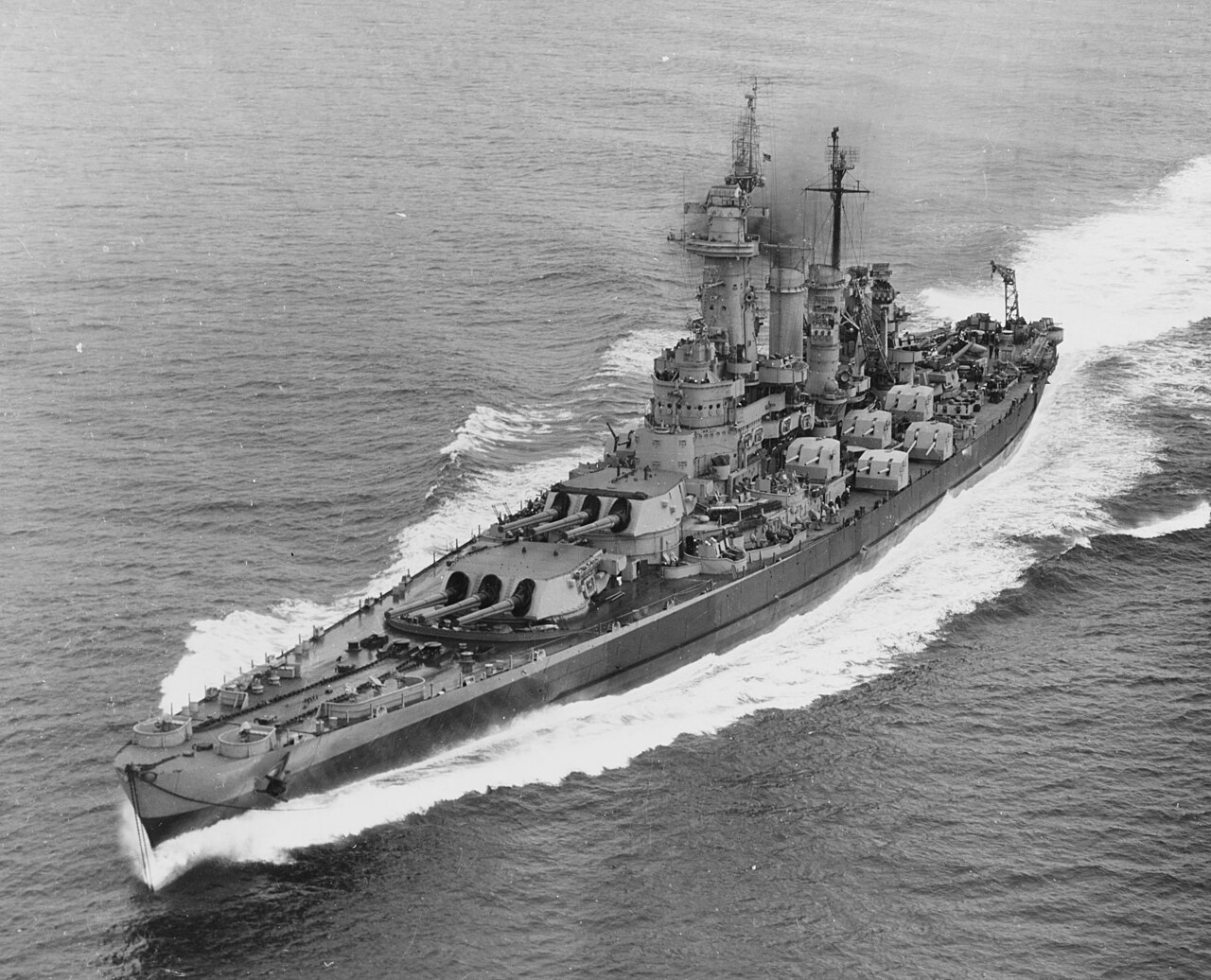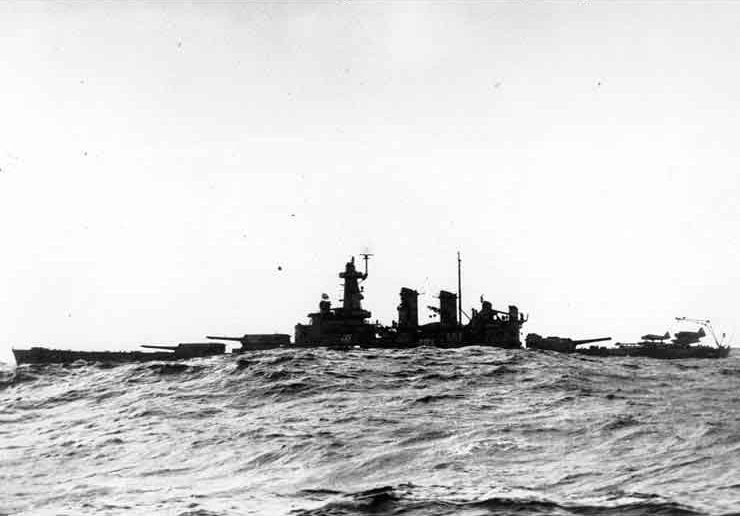
USS Washington (BB-56) was the second of the North Carolina class, the first American battleships in a generation built to carry nine 16-inch guns at fleet speed. The treaty weight was about 35,000 tons, and the hull was made long so she could make the speed. The armor was thinner than the next class would carry. The Philadelphia Navy Yard laid her down on 14 June 1938, launched her on 1 June 1940, and commissioned her on 15 May 1941.
In March 1942 she went out to serve with the British Home Fleet. Rear Admiral John W. Wilcox Jr. flew his flag in her. On 26 March she sailed from Portland, Maine, with the carrier Wasp and the heavy cruisers Wichita and Tuscaloosa, bound for Scapa Flow. The next morning, in heavy weather, a lookout cried man overboard. A muster found that Wilcox was the man missing. No one had seen him go. The destroyer Wilson sighted a body in the water and could not pick it up. The search was abandoned. He was not recovered. Rear Admiral Robert C. Giffen, in Wichita, took the force on. It reached Scapa Flow on 4 April and joined the Home Fleet under Admiral Sir John Tovey, whose flag was in King George V. Washington worked with that fleet into July. She fought no surface action there.
On the night of 14-15 November 1942 she was Rear Admiral Willis A. Lee's flagship off Savo Island. Captain Glenn B. Davis had the ship. South Dakota was astern. Four destroyers were ahead: Walke, Benham, Preston, and Gwin. Vice Admiral Kondo was coming to shell Henderson Field. His flag was in Atago, with Takao and the battleship Kirishima, the light cruisers Nagara and Sendai, and nine destroyers.
The Japanese cruisers and destroyers sank Walke and Preston, wrecked Benham, and damaged Gwin. Washington did not sink them. She was not hit.
The shock of South Dakota's own guns had started an electrical failure, and South Dakota was nearly blind. Searchlights found her. Kirishima hit her with 14-inch shells. Atago, Takao, Nagara, and Sendai hit her as well. She took more than two dozen shells. She was not sunk, and she did not sink Kirishima. While the Japanese were shooting at her, they had not seen Washington.
Lee opened with the 16-inch guns at about 8,400 yards. Washington wrecked Kirishima. At 03:25 on 15 November Kirishima capsized. Washington's gunfire is also the fire credited with sinking Ayanami.
She was not hit that night, not by a shell and not by a torpedo. No one on her was killed. She stayed in the Pacific after that, and she was in overhaul at Puget Sound through the last two months of the fighting. On 10 September 1945 she was on trials there. The Navy decommissioned her on 27 June 1947.