Ships
- USS Lexington (CV-2) Flag, not her captain, 8 May 1942
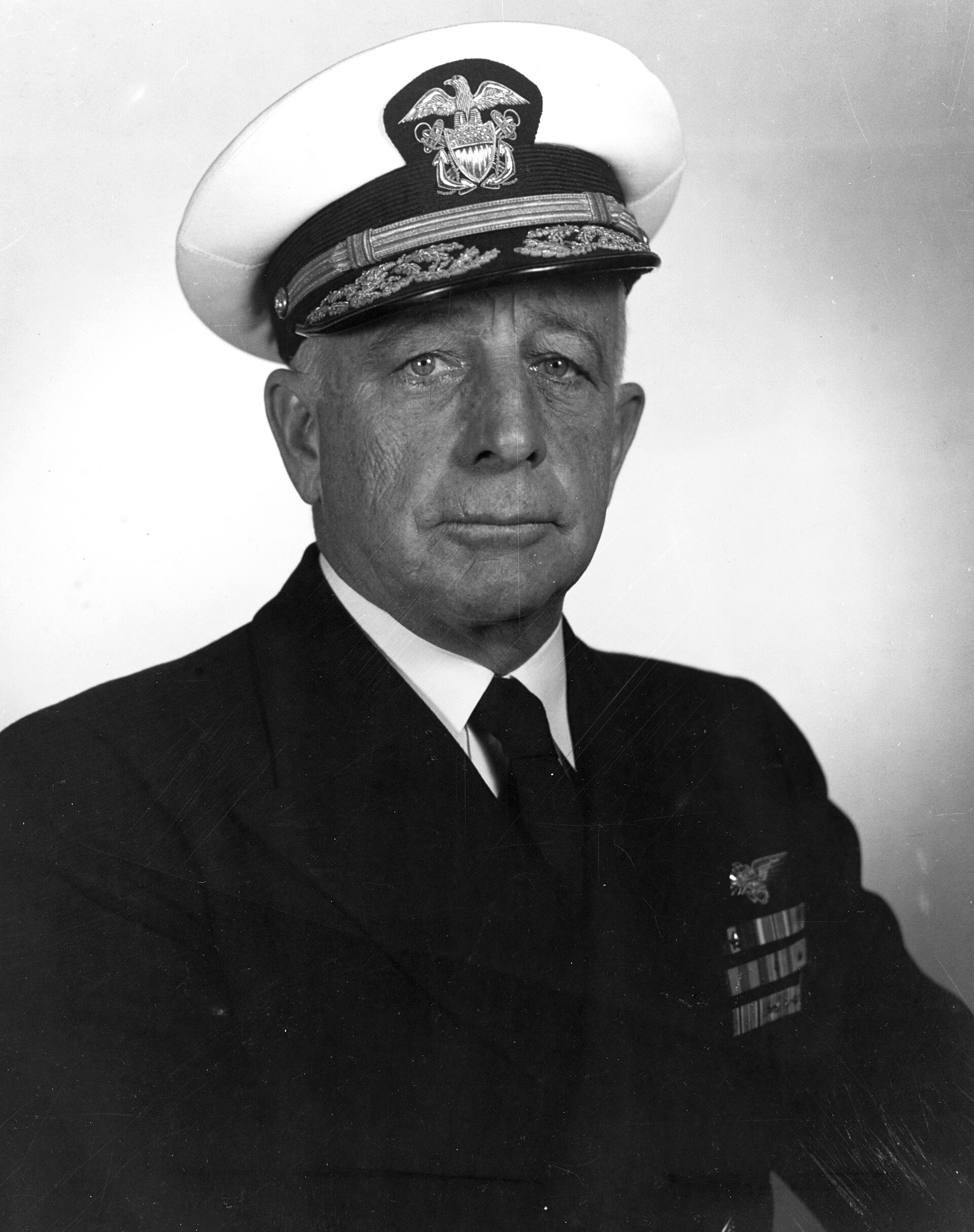
Aubrey Wray Fitch was a United States Navy officer who came out of the battleship fleet and finished as one of the Navy's senior aviators. On 8 May 1942, in the Battle of the Coral Sea, Rear Admiral Fitch flew his flag in Lexington (CV-2). He was not her captain. Captain Frederick C. Sherman commanded the ship. Lexington was sunk that day, and Fitch survived. The carrier was the original Lexington (CV-2), a different ship from the later Lexington (CV-16).
He was born in Saint Ignace, Michigan, on 11 June 1883, and graduated from the United States Naval Academy on 12 February 1906. The law then kept a midshipman at sea for two years before he was commissioned. Fitch spent that time in the armored cruiser Pennsylvania and the destroyer Chauncey. He qualified in torpedoes, taught at the Naval Academy, and in 1914 served on the Atlantic Fleet staff while commanding Yankton. For most of the First World War he was gunnery officer of the battleship Wyoming.
After the war he held shore assignments, commanded a division of destroyer minelayers, and served with the United States mission to Brazil. He was executive officer of the battleship Nevada and commanding officer of the stores ship Arctic. In June 1929, in his mid-forties, he began flight training at Naval Air Station Pensacola and was designated a naval aviator on 4 February 1930. He then commanded the seaplane tender Wright, the carrier Langley, and Naval Air Station Hampton Roads, and from 1935 into 1936 he was chief of staff to the commander of the Battle Force's aircraft.
In April 1936 Fitch took command of Lexington (CV-2), the big carrier that would later carry his flag. Albert W. Marshall had been her first commanding officer when she joined the fleet in the late 1920s. Fitch left her in 1937 for the senior course at the Naval War College in Newport, Rhode Island. He commanded Naval Air Station Pensacola from June 1938, took charge of Patrol Wing Two at Pearl Harbor in April 1940, and that November became Commander, Carrier Division One, a rear admiral with his flag in Saratoga.
On 7 December 1941 Saratoga was steaming toward San Diego after a refit at Bremerton, so Fitch was on the West Coast when the Japanese attacked Pearl Harbor. He took her out on the attempt to relieve Wake Island, which was recalled before the force arrived. In the spring of 1942 the Navy sent him back to the South Pacific. On 3 April he relieved Vice Admiral Wilson Brown and again made Lexington his flagship, in command of the carriers assigned against the Japanese move on Port Moresby.
On 7 and 8 May 1942 the two fleets struck each other with aircraft and stayed beyond the reach of surface guns. Task force commander Frank Jack Fletcher gave Fitch tactical direction of Task Group 17.5, Lexington and Yorktown (CV-5). American carrier planes turned back the seaborne attack on Port Moresby, sank the Japanese light carrier Shoho on 7 May, and left the carrier Shokaku badly damaged the next day. On 8 May Japanese aircraft put torpedoes and bombs into Lexington. Gasoline vapor later exploded in the hull, the crew abandoned her, and the destroyer Phelps sank the burning ship with torpedoes. Fitch sent his staff off before he left the ship. For his leadership over those two days he received the Navy Distinguished Service Medal.
He next flew his flag in Saratoga as she came out of repair. The group arrived too late for the Battle of Midway and instead carried reinforcement aircraft to the atoll. In September 1942, by then a vice admiral, he became Commander, Aircraft, South Pacific Force, and held that command through the Guadalcanal campaign until April 1944. He flew into the Solomons to inspect airfields and to choose sites for new bases. That service brought him a second Distinguished Service Medal and the Distinguished Flying Cross.
In August 1944 he went to Washington as Deputy Chief of Naval Operations for Air and remained there through the end of the war, overseeing naval aviation, the readiness of air units, and the supply arrangements that kept them in action. From August 1945 to January 1947 he was Superintendent of the Naval Academy, the first naval aviator in that post. He retired in July 1947 with the rank of admiral and died on 22 May 1978.