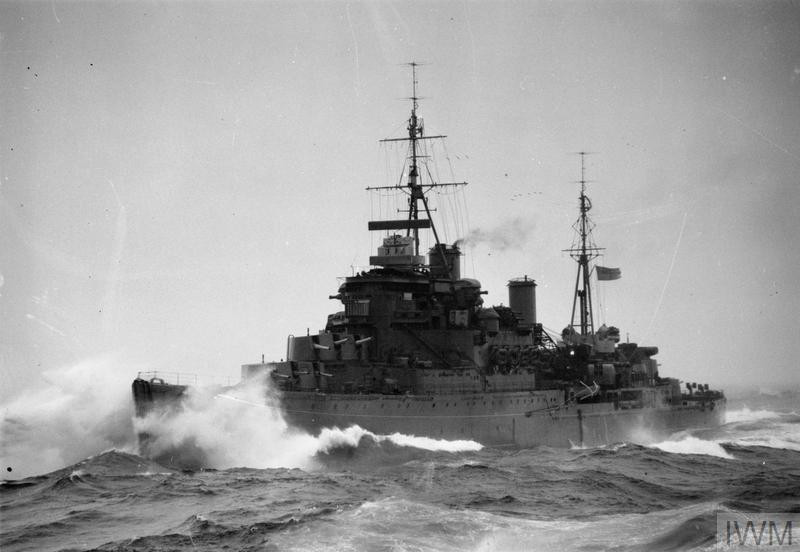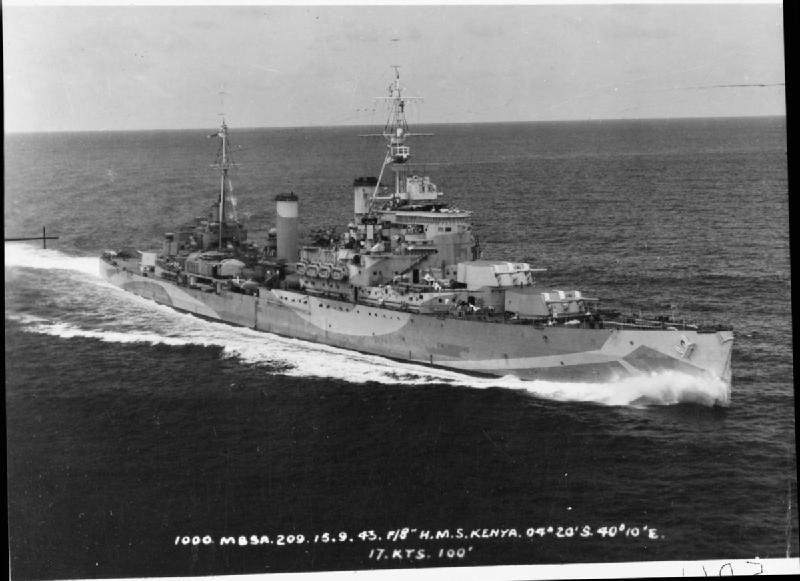
Kenya was a Fiji-class light cruiser, pennant 14, the first Royal Navy ship of the name. Alexander Stephen of Govan laid her down on 18 June 1938 as Job No. 566, under the 1937 Estimates. Uboat.net gives the order as 20 December 1937 and the builder as A. Stephen and Sons Ltd. of Glasgow. The Duchess of Gloucester launched her on 18 August 1939. The naval-history chronology commissions her for service on 28 August 1940 under Captain Michael Maynard Denny. Three hundred of the ship's company came from the cruiser Exeter. She carried a Type 279 air-warning radar. Derby adopted her in March 1942 after a Warship Week. Uboat.net dates the commissioning 27 September 1940 and Denny's command from 18 July 1940 to 1 April 1942.
Denny had her for the Atlantic convoy work of 1941 and for the Bismarck pursuit. On 22 May 1941 she sailed from Scapa Flow with King George V, Victorious, Aurora, Galatea and Hermione. After Hood was sunk she was detached with Hermione and Aurora to screen Victorious during the air operations. Through 1941 and into 1942 she was on Malta convoys and Arctic duty. The chronology's battle honours list the Atlantic in 1941, the Bismarck action, Malta convoys in 1941 and 1942, the Arctic in 1941 and 1942, and Norway in 1941.
Captain Alfred Spalding Russell relieved Denny on 1 April 1942. In August she was with the covering force for the Pedestal convoy to Malta. On the 11th Eagle was hit by torpedoes from U-73 and sank. On the 12th the Italian submarine Axum hit Nigeria and Cairo. Kenya took over control of the convoy and was herself hit forward by one of four torpedoes from the Italian submarine Alagi. The bow was damaged. She stayed with the merchant ships. A near miss later damaged a propeller. She reached Gibraltar on the 15th, lost the temporary bow structure on the passage to Scapa Flow, and went to a South Shields yard on the Tyne at the end of the month. The refit ran to the end of the year and took out her aircraft fittings. She was nominated for the Eastern Fleet.
The chronology records a command change on 8 January 1943. Uboat.net dates Captain Dering Parker Evans from 1 January 1943. She worked up at Scapa Flow, covered WS 28 out to the Cape, and on 25 April detached from that convoy and began duty with the Eastern Fleet at Kilindini. In June she reached Trincomalee. Commander Theodore Edward Podger had her from 24 August to 4 September 1943, with Rear-Admiral W. G. Tennant's flag embarked for exercises off Kilindini. Captain Charles Livingston Robertson took her on 4 September 1943 and kept her until 25 June 1945.
Under Robertson she was in the Eastern Fleet's strikes against Japanese-held ports. On 6 May 1944 she joined Force 65, wearing the flag of the officer commanding the 4th Cruiser Squadron, to cover Illustrious and the American carrier Saratoga in the attack on Surabaya, which the chronology prints as Sourabaya. That was Operation Transom. The force fuelled at Exmouth Gulf on the 15th, covered the raid on the 17th, and was back at Trincomalee on the 27th. In June, as Force 60 with Illustrious, Renown, the French battleship Richelieu, Nigeria and Ceylon, she covered the attack on Port Blair in the Andamans, Operation Pedal, and returned on the 23rd. On 22 July she sailed in Force 62 for Operation Crimson, air strikes on the airfields near Sabang and a bombardment of the harbour. On the 25th she fired on the wireless station at Pulo We and answered the shore batteries. The battle-honour line gives her Sabang 1944.
In August 1944 she escorted Howe into Colombo and then went out in Force 64, with Victorious, Indomitable, Howe and Ceylon, for Operation Banquet, air attacks at Padang and at the place the chronology prints as Emmerhaven, a diversion during American operations in New Guinea. In September, Operation Light, Force 63 struck at the railway works at Sigli in Sumatra. The first part was abandoned for weather. She covered the air operations on the 18th. In October she escorted the submarine depot ship Maidstone from Ceylon to Fremantle. On 22 November she transferred to the 5th Cruiser Squadron of the East Indies Fleet when the British Pacific Fleet was formed. In December she was in Force 61 with Newcastle, Nigeria and Phoebe while the Commander-in-Chief visited the Burma coast bases. The honour line gives her Burma 1944–45.
On 26 January 1945 she gave gunfire support before Royal Marines landed on Cheduba Island, Operation Sankey, and on the 28th she supplemented the bombardment for the landings on Ramree, Operation Matador. In February she sailed with the escort carriers Empress and Ameer as Force 62 for Operation Stacey, photographic reconnaissance over the Kra Isthmus, Phuket, Penang, the Langkawi and Butong islands, Victoria Point and northern Sumatra. On 1 March the force was under air attack, and the carrier aircraft drove it off. On 15 March she fired in support of the landing at Letpan, Operation Turret. She was then released from the Eastern Fleet. At Durban in April the after 6-inch mounting, X turret, was removed. She embarked gold bullion, reached Sheerness on 13 May 1945, and paid off into dockyard control at Chatham in June for a long refit. She was still in that refit when Japan surrendered.
Commander John William Radcliffe Thompson had her from 25 June 1945 until 2 April 1946, through the refit. She was recommissioned in April 1946 for the West Indies. She was not sunk. She paid off for the last time in September 1958. In 1962 she was sold to BISCO, allocated to Shipbreaking Industries at Faslane, and arrived in the Clyde on 27 October. She broke adrift before she could enter the yard and was taken alongside for demolition on 29 October.
A note on sources. The operations follow the naval-history.net service history by Lieutenant-Commander Geoffrey B. Mason That page is a digitized copy. It prints Sourabaya, Emmerhaven, Pulo We, and a doubled 'Type 281, Type 281' in the 1942 refit note. It names only Denny. The other commanding officers and their dates are from the uboat.net ship page, except where Mason records an unnamed command change. He does that on 8 January 1943. Uboat.net hands the ship from Russell to Evans on 1 January 1943. The command lines use 8 January. Podger's start on 24 August 1943 matches Mason's 'Command change' that day. Commissioning is 28 August 1940 on Mason's page and 27 September 1940 on uboat.net. Laid down, 18 June 1938, and launched, 18 August 1939, agree. The sale and the arrival at Faslane are Mason's 1962 paragraph. Uboat.net says she was sold on 29 October 1962 and broken up at Faslane. Pennant 14 is uboat.net. Battle honours on Mason's page include Sabang 1944 and Burma 1944–45, which match the diary, and Korea 1950–51, which is after the war against Japan. No slug in the battle list is Transom, Pedal, Crimson, Banquet, Light, Sankey, Matador, Stacey or Turret. No Navy List or unithistories page was fetched for Russell, Evans, Podger, Robertson or Thompson. Denny was already on the captain list as the same man.