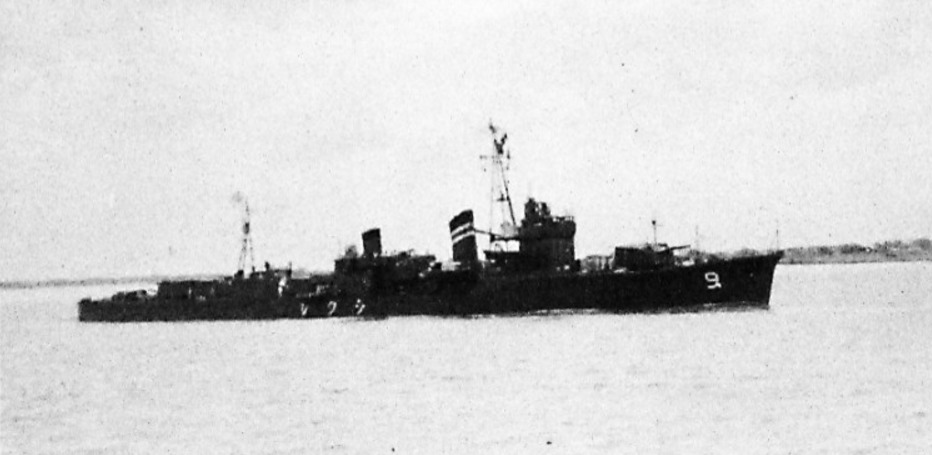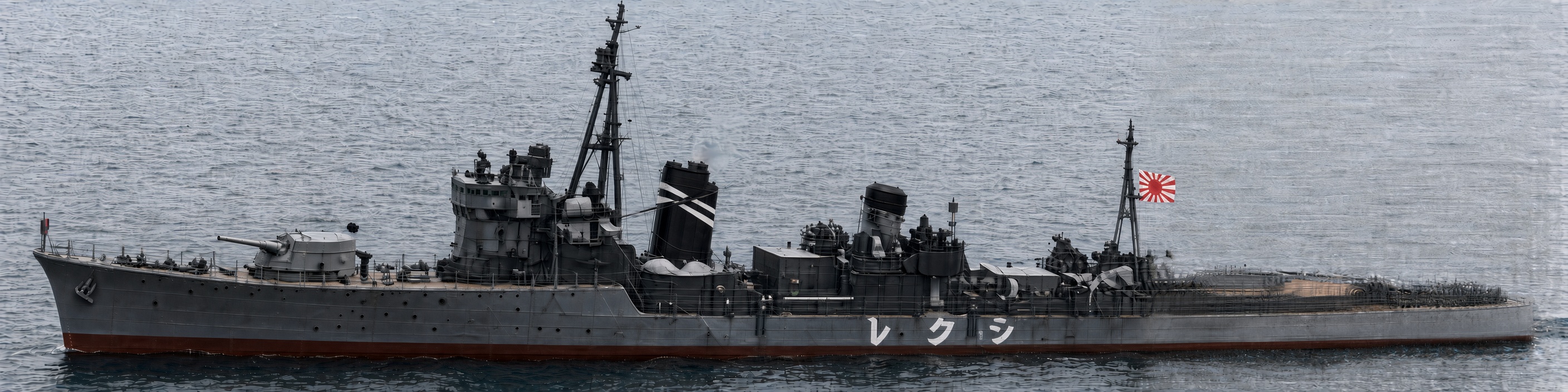
Shigure (時雨, “autumn shower” or “drizzle”) was a Shiratsuyu-class destroyer of the Imperial Japanese Navy. She was not the fastest or most heavily armed ship in the fleet. She became famous because she kept coming back when the ships around her did not. Together with Yukikaze, she was one of the two destroyers Japanese sailors called lucky, or unsinkable. That reputation was earned in the Solomons and sealed at Surigao Strait. It ended in the Gulf of Siam on 24 January 1945.
A working destroyer, not a flagship
Shigure was laid down at Uraga Dock Company on 9 December 1933, launched on 18 May 1935, and commissioned on 7 September 1936. She displaced about 1,685 long tons standard, was 107.5 meters at the waterline, and was designed for 34 knots, with five 12.7 cm guns and eight 610 mm torpedo tubes. The complement was about 226. She was built to screen the battle line and fight at night with the Long Lance. None of the ten ships of her class survived the war. She was the last still afloat in 1945.
Before Pearl Harbor she had already seen China: shore bombardment at Shanghai in 1937, and river work on the Yangtze during the Wuhan campaign. When the Pacific War opened she was in home waters with Destroyer Division 27, screening capital ships and hunting submarines. She escorted the Pearl Harbor striking force home in December 1941, then spent early 1942 on carrier escort, including the Coral Sea with Takagi’s force, and Midway with the Aleutians guard force, which did not fight the carrier battle. By autumn she was on the Tokyo Express to Guadalcanal. On the night of 12–13 November 1942 she screened the distant force at the first night action off Guadalcanal, and later picked up survivors from the battleship Hiei.
That was the pattern: escort, run troops in the dark, pull men out of the water, go back.
The year she became a legend
In 1943 Captain Tameichi Hara, already a noted torpedo tactician, took Destroyer Division 27 and flew his flag in Shigure. On paper the division was several destroyers. Most of the time the others were elsewhere, so the division he actually had was this one ship. He was not her captain. Her own captain still had the deck. With Hara aboard she went through the last months of the Solomons almost without losing a man in combat. Japanese wartime publicity later called her the indestructible destroyer. Hara’s postwar memoir is the main first-person account of what that felt like from the bridge.
The night that fixed her reputation was 6–7 August 1943, in Vella Gulf. Four Japanese destroyers, Hagikaze, Arashi, Kawakaze, and Shigure, were running about 950 troops and supplies through Blackett Strait toward Kolombangara. Hara had argued against repeating the same route on the same schedule. He was overruled.
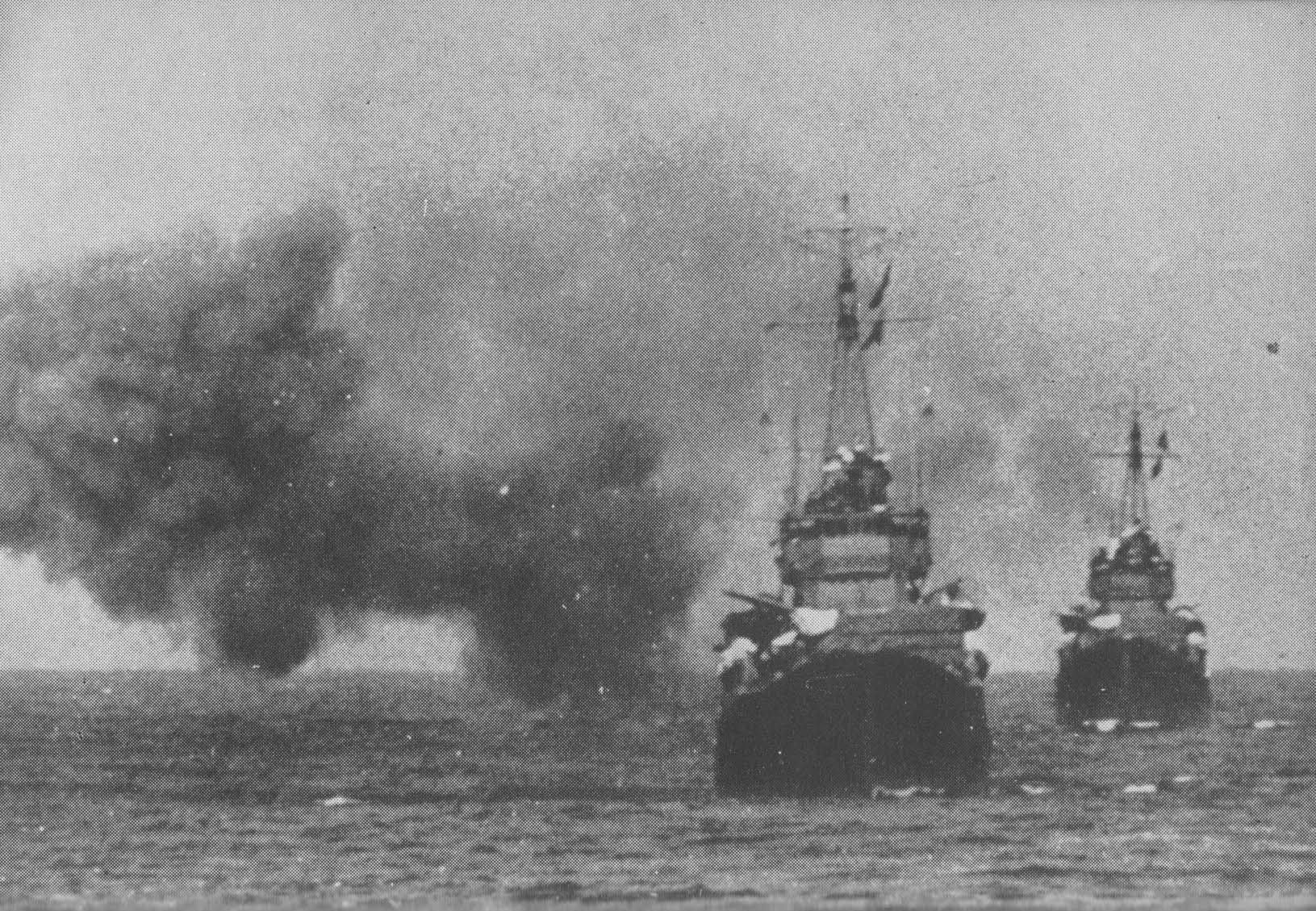
Six American destroyers under Commander Frederick Moosbrugger closed by radar and fired twenty-four torpedoes in a minute. Three Japanese ships exploded. Hundreds of sailors and soldiers died in the water. Shigure, trailing, turned hard. One torpedo punched clean through her rudder and did not detonate. No one destroyer is named for that shot. She fired eight torpedoes of her own, missed, made smoke, and ran. Later, in drydock at Sasebo, engineers found a hole roughly two feet across in the rudder, already growing barnacles. Hara’s remark was that the helm had been sluggish for months and they had kept operating anyway. Had the exploder worked, she would have been the fourth wreck in the gulf.
She went straight back to work. At Horaniu in mid-August she fought American destroyers without damage while covering a landing. On 6–7 October, at Vella Lavella, she and Samidare were in the fight. Yugumo charged and was sunk. One of Yugumo’s torpedoes wrecked Chevalier. That was not Shigure’s torpedo. O’Bannon then collided with Chevalier. Shigure and Samidare were the ships Selfridge was firing at when a torpedo blew Selfridge’s bow off. Which of the two fired it is not known. At Empress Augusta Bay on 2 November she again engaged an American cruiser-destroyer force and came away unhit. Hatsukaze was sunk in that fight. When Shigure finally docked at Sasebo in November 1943, she had spent months in the most dangerous waters in the Pacific and still had not lost a crewman in battle.
Luck was never complete. In February 1944 an air raid on Truk put a bomb into No. 2 turret: 21 dead, 45 wounded. The wrecked turret was later replaced with extra 25 mm antiaircraft mounts. The raid is not pinned to one aircraft. In June, on the Biak run, she pulled 110 men off the sinking Harusame, then took two shell hits from Allied cruisers and destroyers: seven dead, fifteen wounded. At the Philippine Sea she helped rescue survivors of the carrier Hiyo. The ship that could not be sunk was already scarred.
Surigao Strait
In October 1944 Shigure sailed with Vice Admiral Shoji Nishimura’s Southern Force for Leyte. The plan was to force Surigao Strait at night and hit the American landing. On 24 October a bomb hit her forward turret: five dead, six wounded. The next night was worse.
Nishimura’s column, the battleships Yamashiro and Fuso, the cruiser Mogami, and the destroyers, steamed into a prepared ambush of PT boats, destroyer torpedo attacks, and then a battle line of old battleships. Fuso broke apart. Yamashiro burned and sank. The other destroyers died around them. Shigure took a shell hit and near-misses that wrecked her radio, compass, and steering. The shell is not pinned to one American ship. Mogami came out of the strait on fire, and Akebono scuttled her that afternoon. Shigure was the only ship of Nishimura’s column still underway. She limped into Brunei on 27 October.
On the way home in November she was among the escorts in the counterattack when the submarine Growler was lost off Mindoro. That loss is not pinned to her. In December she left Kure with the new carrier Unryu for Manila. The submarine Redfish sank Unryu. Shigure and Momi took off 146 survivors. Shigure turned for Sasebo. Momi and Hinoki went on and were both lost with all hands. Once again she was the ship that came back.
The end of the streak
On 24 January 1945 she was escorting a convoy from Hong Kong toward Singapore. In the Gulf of Siam, about 160 miles east of Kota Bharu, the submarine Blackfin fired. A torpedo hit Shigure in the port quarter around 07:05. The No. 2 magazine exploded. She listed, the crew abandoned, and at about 07:15 she went down stern first. She sank slowly enough that 270 men got off. Thirty-seven died. The escorts Kanju and Miyake picked up the survivors. She was struck from the navy list on 10 March 1945, the last of her class.
Hara was already gone by then. He later commanded the cruiser Yahagi on Yamato’s last sortie, and survived that too. The luck that attached to the hull did not transfer to whoever stood on her bridge at the end.
What the luck was
Shigure was not untouched. She was holed, bombed, and shelled. Men died on her decks. What set her apart was repetition: sole survivor of a four-destroyer force at Vella Gulf, sole ship of Nishimura’s column still underway at Surigao, last Shiratsuyu still steaming into 1945, and repeatedly the ship that stopped to pull other crews out of the water. Japanese sailors paired her with Yukikaze. Yukikaze finished the war almost unmarked. Shigure finished it on the bottom, but only after walking through two annihilations.
The story is not magic. American torpedoes in 1943 often failed to explode, and one of those failures saved her. Hara was a careful night fighter who objected to repeating a predictable route. He rode her as division commander, not as her captain, and most nights she was the only ship of that division he had. Radar, numbers, and the shortage of oil did the rest of the war. From the men who rode her, the pattern was simple: when the column died, Shigure was the one still making smoke and heading for home.