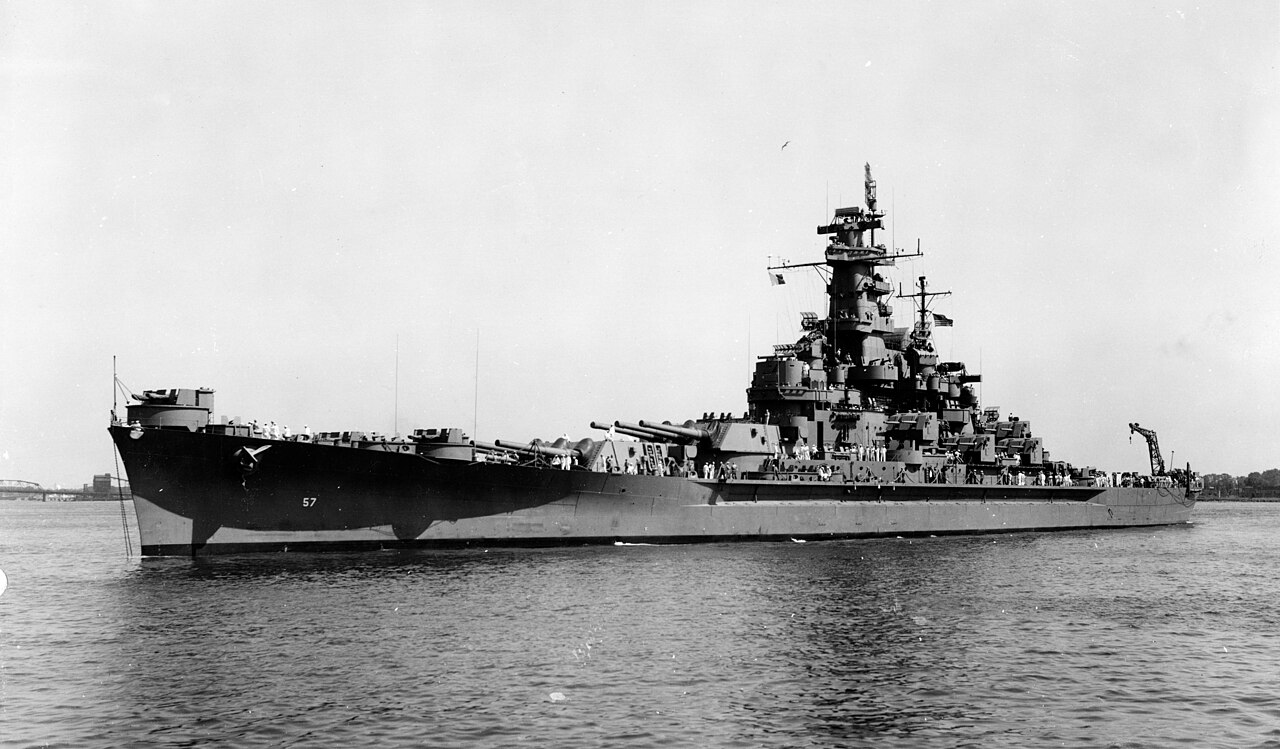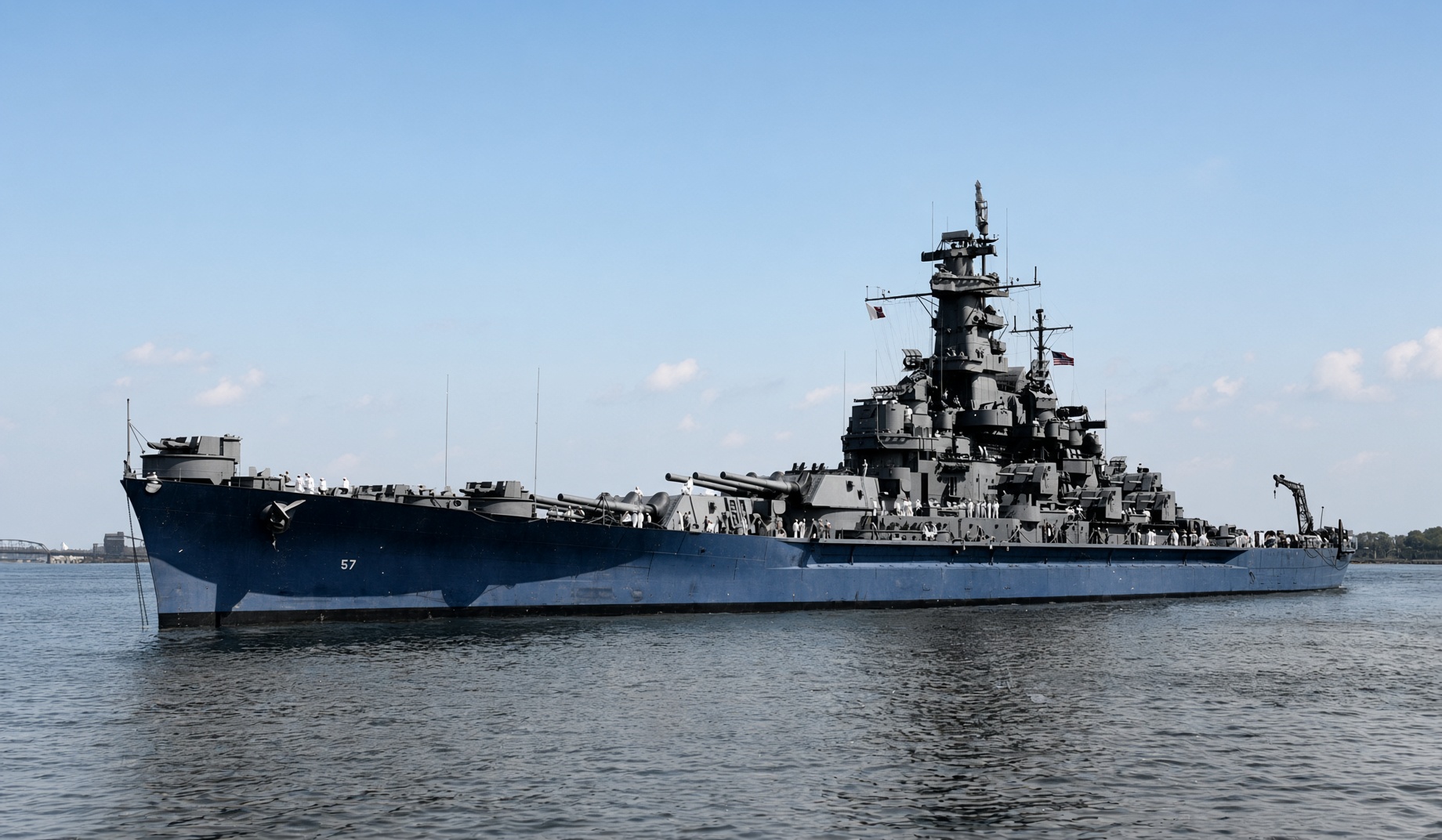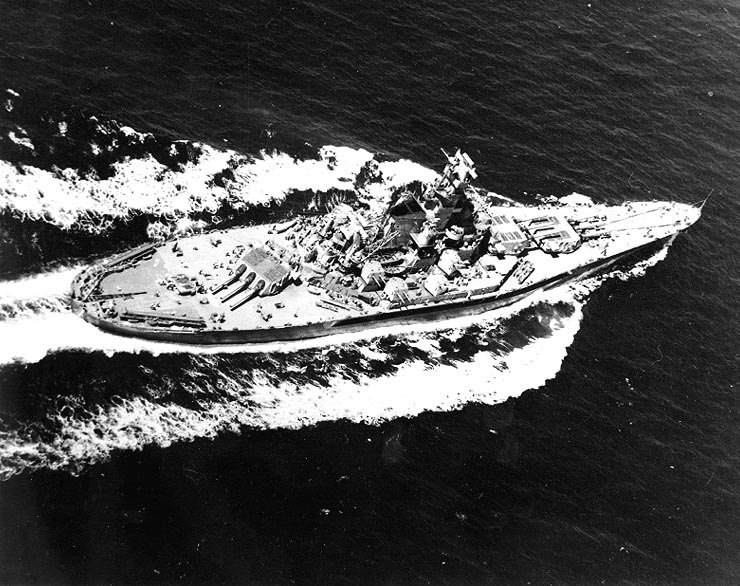
USS South Dakota (BB-57) was the name ship of her class, and the second ship to carry the name. An earlier class of that name had been canceled after the First World War. She was not Washington. The North Carolina hulls had been made long to buy speed, and the armor had paid for it. South Dakota was cut shorter so the same treaty weight could go into protection. She still carried nine 16-inch guns. The Navy recorded her at 35,000 tons, 680 feet, sixteen 5-inch guns, and 27.8 knots. The sixteen 5-inch guns were fewer than her sisters mounted, because room had been taken for a flagship. The ship was cramped, and she was hard to live in. New York Shipbuilding, at Camden, laid her down on 5 July 1939, launched her on 7 June 1941, and commissioned her on 20 March 1942. Thomas L. Gatch had her. In the wartime press she was Battleship X, so a story could not say which ship had done the fighting.
Her shakedown ran from 3 June to 26 July 1942. She left Philadelphia on 16 August, passed the Canal on 21 August, and reached Tongatabu on 4 September. Two days later she struck an uncharted coral pinnacle in Lahai Passage and ripped her hull. She sailed for Pearl Harbor on 12 September and was ready for sea again on 12 October.
On 16 October she sailed from Pearl Harbor with the force built around Enterprise. They met Hornet's force on the 24th. On 26 October, off the Santa Cruz Islands, she stood near Enterprise and put up a heavy antiaircraft fire. A 500-pound bomb hit the roof of Turret I. It did not go through the armor. A splinter cut Gatch's throat, one man later died of his wounds, and dozens more were hurt. Two of the guns in the next turret were gouged so badly they could not be fired. She would fight the November night with seven main-battery guns, not nine. The Navy credited her with 26 aircraft that day. At 04:14 on 30 October, while she was turning away from a submarine contact, she collided with Mahan (DD-364). Both ships were damaged, and both went on to Noumea, where Vestal patched the collision and the bomb hit.
On the night of 14-15 November she was astern of Washington, off Savo Island. Rear Admiral Willis A. Lee had the force. Before a Japanese shell hit her, the shock of her own salvo started an electrical failure. The radar went, and much of the power with it. She was nearly blind. Searchlights found her. Kirishima hit her with 14-inch shells. Atago, Takao, Nagara, and Sendai hit her as well. She took more than two dozen shells. The first report said 42. About forty men were killed, and many more were wounded. Gatch was wounded again. The superstructure was a wreck. The hull held. She was not sunk.
She did not sink Kirishima. Washington did, with 16-inch gunfire, and Kirishima capsized at 03:25. The Japanese cruisers and destroyers sank Walke (DD-416) and Preston (DD-379) and wrecked Benham (DD-397). Those losses are not South Dakota's. Wartime accounts that gave her the night were ahead of the evidence. The Navy Unit Commendation for the ship covers Santa Cruz and that November night. Prometheus did what could be done at Noumea. She sailed on 25 November and reached New York on 18 December 1942.
Lynde D. McCormick relieved Gatch on 1 February 1943. She was back at sea on 25 February and worked with Ranger in the North Atlantic until the middle of April, then with the British Home Fleet from Scapa Flow until 1 August. She returned to Norfolk. On 21 August she sailed for Efate and arrived on 14 September. Allan E. Smith took her on 20 September.
Through the winter she screened the fast carriers and fired on shore. In November the carriers hit Jaluit and Mili, then covered the landings at Makin and Tarawa. On 8 December she was one of six battleships that shelled Nauru. On 30 January 1944 she shelled Roi and Namur. In February she was with the strike on Truk, and then with the first carrier attacks on the Marianas, where she was credited with four aircraft. At the end of March and the first of April the carriers hit Palau, Yap, Woleai, and Ulithi. In April she screened the strikes on Hollandia and a return to Truk, and on 1 May she was in the group that shelled Ponape. Ralph S. Riggs had relieved Smith on 17 March, so Palau and what followed were his.
On 13 June she and six other battleships left the carriers to bombard Saipan. She fired on Tanapag Harbor for more than six hours. On 19 June, in the Philippine Sea, a bomb hit her main deck. It blew a hole, cut wiring and piping, and killed 24 men. Twenty-seven were wounded. She stayed in the fight. Japanese carrier planes were destroyed in great numbers that day and the next. None of those ships is credited to her. She reached Puget Sound on 10 July for an overhaul and sailed again on 26 August. By October she was back with the fast carriers for Okinawa, Formosa, and the Philippines. Riggs left her on 30 November.
Charles B. Momsen took her on 9 December 1944. Carl R. Stillman, the executive officer, had held her for the ten days between Riggs and Momsen, and he held her again from 30 July to 17 August 1945. Both spells were temporary. Under Momsen she screened the February strikes on Tokyo and the landings at Iwo Jima, then the long bombardment of Okinawa. On 7 April 1945 aircraft from the carriers sank Yamato, and with her two cruisers and four destroyers. South Dakota was with the force. The sinking is not hers. On 6 May, while she was taking powder from Wrangell, a tank of 16-inch powder exploded and set off four more. Three men were killed at once, eight more died of their injuries, and 24 were wounded. She flooded the magazine of Turret II and went to Guam.
She left Leyte on 1 July. On 14 July, still under Momsen, she was in the group that shelled the steel works at Kamaishi. That was the first time heavy ships fired on the Japanese home islands, and the fire belongs to the group. On the night of 29-30 July she shelled Hamamatsu, and Momsen left her on 30 July. During Stillman's second short command the group shelled Kamaishi again, on 9 August. Emmet P. Forrestel took her on 17 August, with the war over. She anchored in Sagami Wan on 27 August and entered Tokyo Bay on the 29th. She was in the bay on 2 September, when Japan signed the surrender on Missouri. She sailed on 20 September. Carlton R. Todd had her from 1 December 1945, and William K. Parsons from 20 June 1946. Matthew S. Schmidling relieved Parsons on 21 December and still had her when the Navy decommissioned her on 31 January 1947. She was struck on 1 June 1962 and sold for scrap on 25 October. Thirteen battle stars. A memorial in Sioux Falls holds pieces of her, a propeller among them.