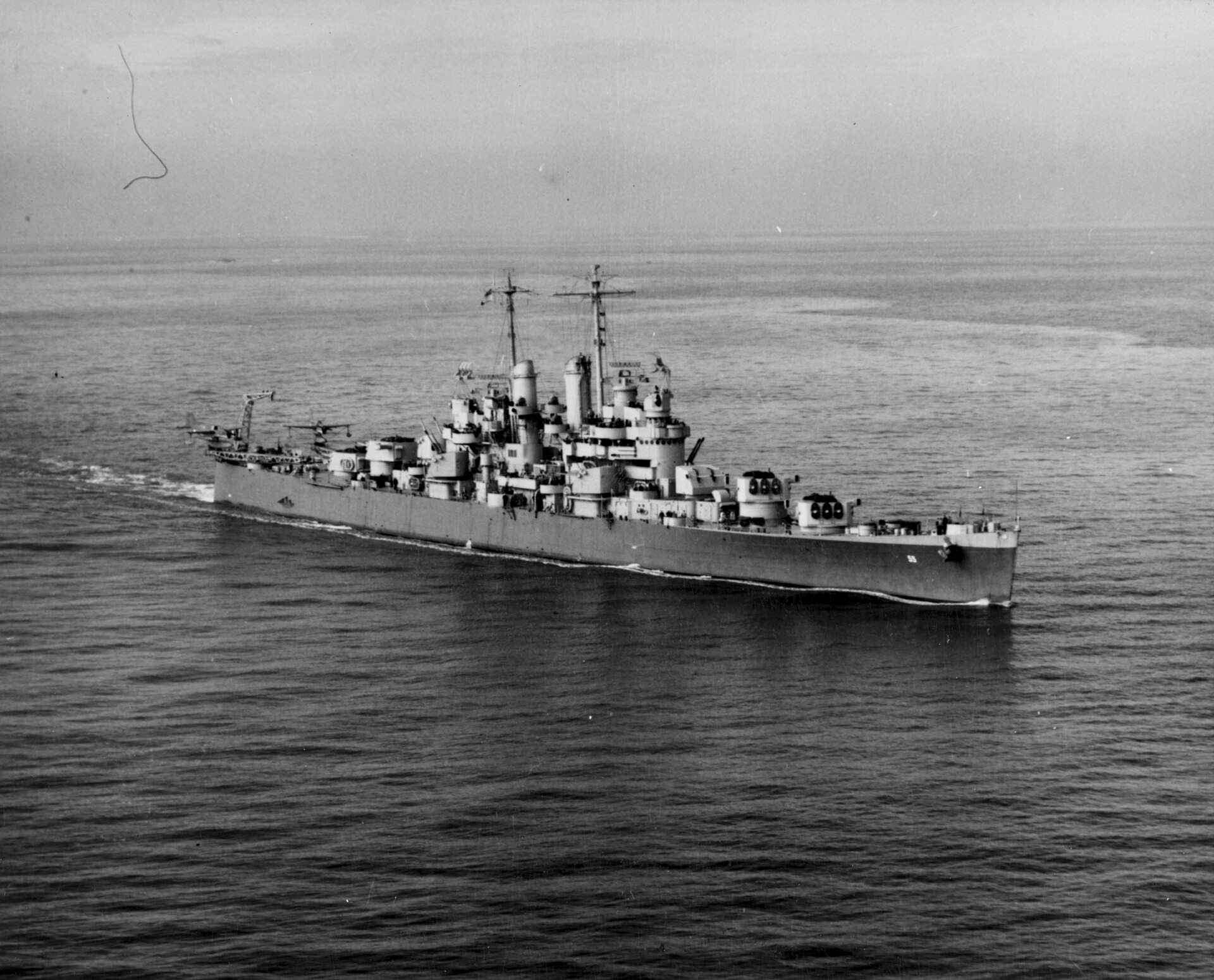
Cleveland was the name ship of her class, a light cruiser built by New York Shipbuilding at Camden. She was laid down on 1 July 1940, launched on 1 November 1941, and commissioned on 15 June 1942. Captain Edmund W. Burrough had her. The name is the city. She carried twelve 6-inch guns in four turrets, and twelve 5-inch. Twenty-seven of the class were finished as cruisers. Nine of the hulls were finished as light carriers.
In November 1942 she was with the ships covering the landings in North Africa, and she earned a battle star for it. She sailed for the Pacific on 5 December and reached Efate on 16 January 1943. Her first fight there was an air attack. From 27 to 31 January she was in Task Force 18, guarding a troop convoy to Guadalcanal. On the night of 29 January, off Rennell Island, Japanese torpedo planes hit the heavy cruiser Chicago and came back the next day and sank her. Cleveland was under the same attacks and fired at the planes. Chicago's loss is not hers.
On 6 March she went up the Slot with Task Force 68 to shell the airfield at Vila, on Kolombangara. The same night the force met two Japanese destroyers, Minegumo and Murasame, coming out of the gulf, and sank them in Blackett Strait. That fire is not credited to one ship. She was not in the night actions of Kula Gulf or Kolombangara. Those were other cruisers. On 12 July she was on the gun line for the landings at Munda.
Command passed to Captain Andrew G. Shepard in June. On the night of 1-2 November 1943 she was in Rear Admiral Aaron S. Merrill's cruiser line off Empress Augusta Bay. Merrill's flag was in Montpelier. Cleveland, Columbia, and Denver were with her, and eight destroyers. Rear Admiral Sentaro Omori had come down from Rabaul to break up the landings at Cape Torokina. His flag was in Myoko, with Haguro. The light cruiser Sendai, Rear Admiral Matsuji Ijuin's flag, had Shigure, Samidare, and Shiratsuyu. Agano had Naganami, Hatsukaze, and Wakatsuki. The American cruisers sank Sendai. That fire is not credited to one of them. Myoko, cutting through the other column, collided with Hatsukaze and cut off her bow. The American destroyers then finished Hatsukaze. That fire is not credited to one of them. Samidare and Shiratsuyu collided and left damaged. Shigure was not hit. Cleveland was not sunk. The next morning a stick of bombs rocked her, and she was still with the force. The Navy Unit Commendation is for that night.
After that she was a gunfire ship. She bombarded Buka again in December, screened the carriers, and in June 1944 was with the fast carriers for the Philippine Sea, where she is credited with one aircraft. Off Tinian on 24 July she put herself between the destroyer Norman Scott and the shore batteries that were hitting her. In February 1945 she fired on Corregidor before the landings. She covered landings in the Philippines and at Brunei. On 30 June, for the bombardment of Balikpapan, General MacArthur and his staff came aboard to watch. In August she was with the sweep into the East China Sea. She was not in Tokyo Bay for the signing. She was there from 28 October to 1 November, then went home by Pearl Harbor and the Canal and reached Boston on 5 December.
She was decommissioned at Philadelphia on 7 February 1947, struck on 1 March 1959, and sold for scrap on 18 February 1960. Thirteen battle stars.