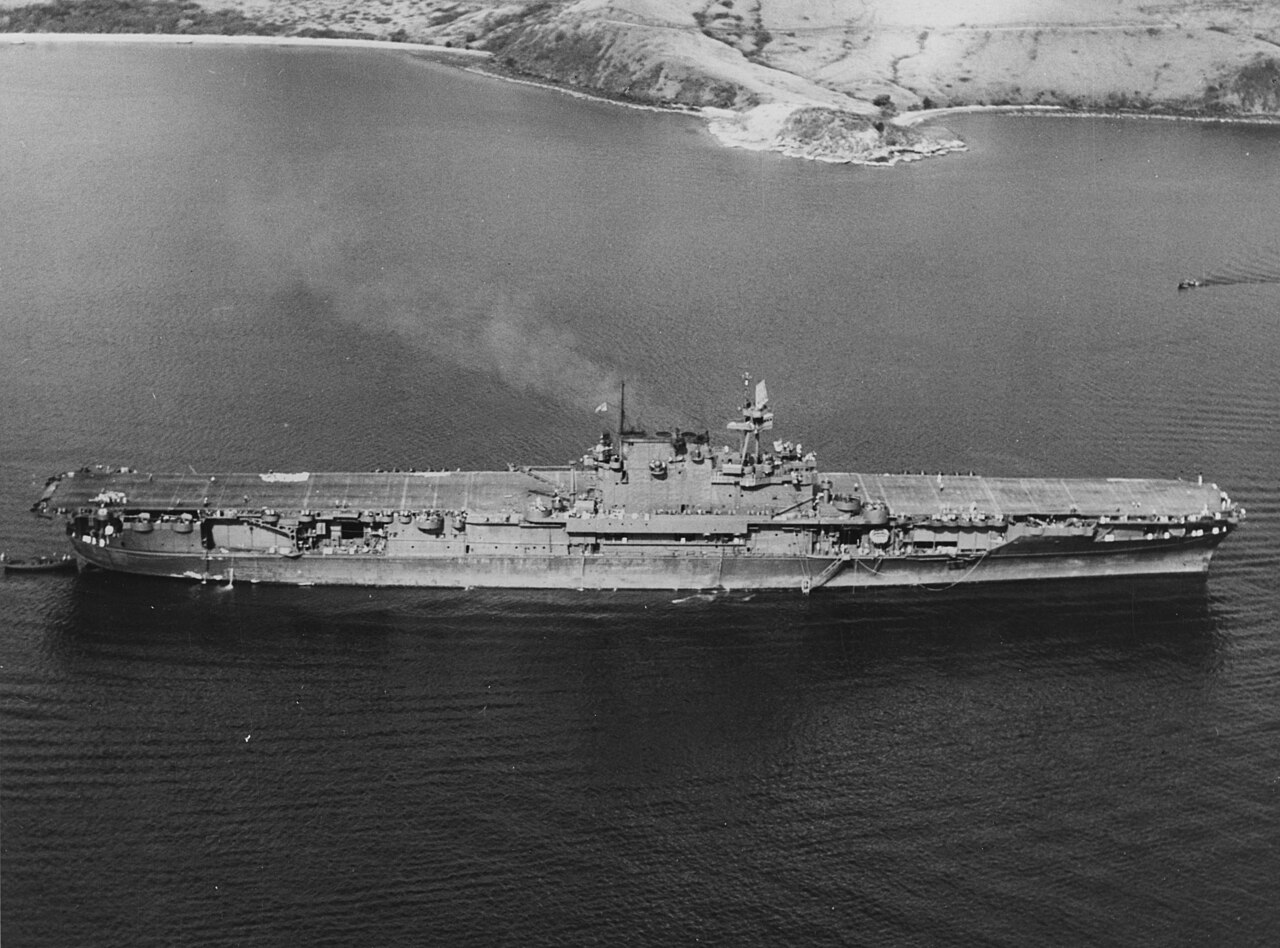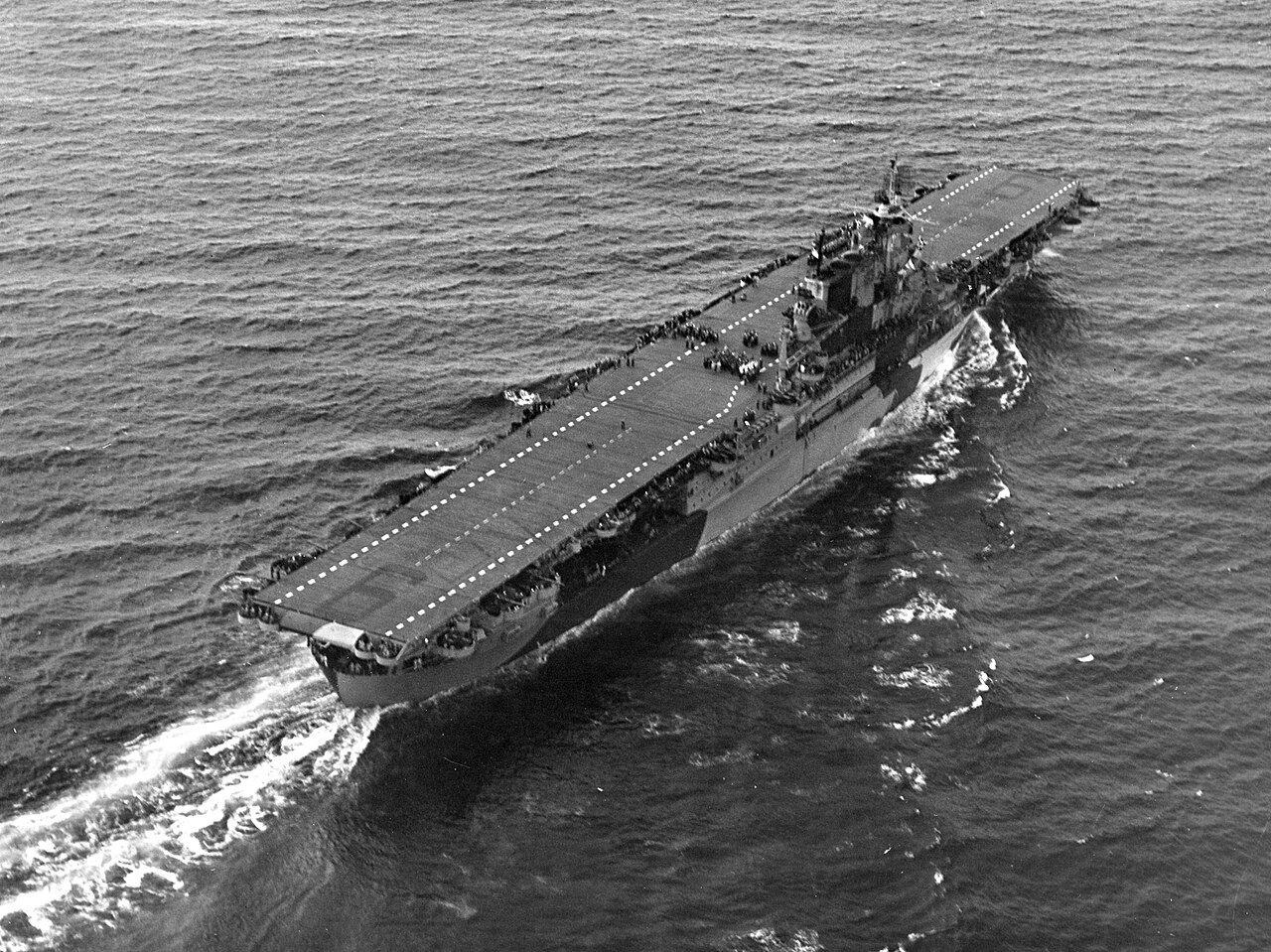
USS Enterprise (CV-6) was the seventh ship of the name, and the crew called her the Big E. Newport News laid her down on 16 July 1934. She was launched on 3 October 1936 and commissioned on 12 May 1938, with Captain Newton H. White Jr. in command. She was a Yorktown-class carrier, one of three, held to a treaty displacement of just under 20,000 tons. The flight deck was wood. The armor was thin. The weight had gone into speed, about 33 knots, and into an air group large enough to matter. A later, nuclear carrier took the name. This is the ship of 1938.
On 7 December 1941 she was at sea, coming home from Wake, where she had just flown a Marine fighter squadron ashore. She was not in the harbor. Eighteen of her dive bombers flew on ahead and into the attack. Seven were shot down. Eight of her men were killed.
In April 1942 she sailed with Hornet. Vice Admiral William F. Halsey flew his flag in Enterprise. Hornet, under Captain Marc A. Mitscher, carried sixteen Army B-25s led by Lieutenant Colonel James H. Doolittle. On 18 April a Japanese picket found the force, still far short of the planned launch. The bombers went off Hornet's deck into a high wind and a rough sea. Enterprise kept fighters overhead. She did not launch the bombers, and she was not hit.
She was then ordered south. The battle in the Coral Sea ended before she could take part.
At Midway she was Rear Admiral Raymond A. Spruance's flagship. She was not hit.
On the morning of 4 June her dive bombers, led by Lieutenant Commander Wade McClusky, were low on fuel and had not found the Japanese carriers. They saw the destroyer Arashi hurrying back after hunting the submarine Nautilus, and they followed her wake. The bombers that hit the fleet were American carrier aircraft, not Enterprise alone. Akagi, Kaga, and Soryu were wrecked that morning. Hiryu was still able to fly. Her planes went after Yorktown and crippled her. They did not hit Enterprise. American carrier aircraft wrecked Hiryu later the same day. All four carriers are credited to those aircraft, not to one ship. On 6 June planes from Enterprise and from Hornet sank Mikuma. American carrier aircraft are credited with that sinking, not one ship.
On 24 August 1942, in the Eastern Solomons, three bombs hit her. Seventy-four men were killed and ninety-five wounded. She was not sunk. She reached Pearl Harbor on 10 September under her own power.
On 26 October, off the Santa Cruz Islands, two bombs hit her, and near misses opened plating along her side. Forty-four men were killed. Captain Osborne B. Hardison kept her flying aircraft. She was not sunk. She took aboard planes from Hornet after that ship could no longer land them. That morning planes from Enterprise had put bombs into Zuiho. Chikuma was hit by planes from Enterprise and from Hornet. Neither of those ships was sunk. Hornet was the carrier lost that day.
Early in November she was still under repair at Noumea, the Santa Cruz damage open in the hull. On 11 November she sailed with repair crews still aboard. Her aircraft joined the daylight attacks on Japanese ships off Guadalcanal. She was not in the night action. The ships sunk that night were not hers.
She was still in the war after Yorktown and Hornet were gone. Off Okinawa a suicide attack damaged her in April 1945. On 14 May a kamikaze went through the flight deck and blew out the forward elevator. She was not sunk. That was her last wound. She came home, carried veterans back from Europe, and was decommissioned on 17 February 1947. She had earned twenty battle stars, more than any other American ship in the war. A campaign to keep her as a memorial failed. She was scrapped. The name went to a nuclear carrier. The Big E did not.