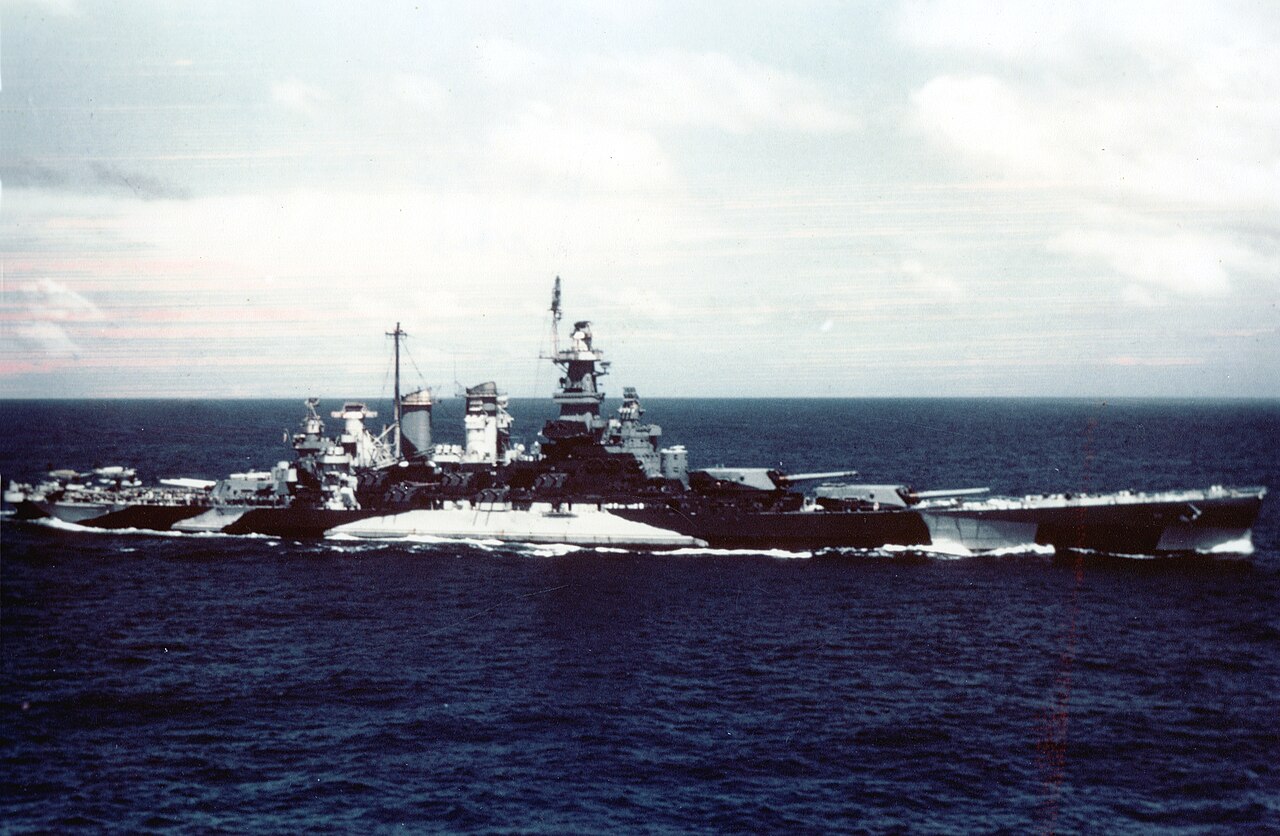
There were earlier ships named North Carolina. This is the one people mean: USS North Carolina (BB-55), the first U.S. fast battleship of World War II, now moored at Wilmington.
Building the Showboat
The Washington and London treaties had kept American battleship construction frozen for sixteen years. When the keel went down at the New York Navy Yard on 27 October 1937, she was the first new U.S. battleship since the early 1920s. Treaty displacement was 35,000 tons. The original plan was twelve 14-inch guns. Japan refused the Second London Treaty, the escalator clause opened, and she received nine 16-inch guns in three triple turrets instead.
She was 728 feet 9 inches long, 108 feet 4 inches in beam, designed for 27 knots. Isabel Hoey, daughter of the governor, sponsored the launch on 13 June 1940. Commissioning was 9 April 1941, Captain Olaf M. Hustvedt in command. She was the first of the Navy's modern battleships into commission. The fitting-out and trials in and out of New York Harbor drew so much press that the nickname stuck: Showboat.
Shakedown was in the Caribbean. Pearl Harbor found her still in the Atlantic. After a brief watch against a possible Tirpitz sortie that never came, she entered the Pacific on 10 June 1942.
Guadalcanal
She covered the 7 August 1942 landings on Guadalcanal and Tulagi, then fought in the Battle of the Eastern Solomons on 23–24 August as part of the screen around Enterprise. Her value in that campaign was not a surface duel. She was a fast battleship that could stay with the carriers and put up a wall of 5-inch and lighter fire.
On 15 September 1942, while Task Force 61 patrolled southeast of Guadalcanal, Japanese submarine I-19 fired a spread that hit three ships. Wasp was fatally wounded. Destroyer O'Brien was hit. An 890-pound warhead struck North Carolina below the armor belt abreast Turret I and tore a hole about 32 by 18 feet. She took a 5½-degree list. Damage control had her back over 20 knots in minutes. She was the only U.S. battleship torpedoed at sea in the war. After repairs she returned to the Solomons.
Carrier screen, 1943–1945
From the Gilberts onward the pattern was set: anti-aircraft screen for the fast carriers, and the 16-inch battery when an island had to be broken.
She was at Tarawa and Makin in November 1943; the Marshalls in January–February 1944; the Marianas and the Battle of the Philippine Sea in June 1944; the western Pacific strikes that fall; Luzon, Iwo Jima, and Okinawa; and the home-islands bombardments in the last weeks. She never fought another battleship. She fired more than 2,200 16-inch projectiles and many thousands of 5-inch shells. Among the targets were Kwajalein, Saipan, Iwo Jima, Okinawa, and the Japanese coast. In one bombardment she sank a transport.
Official credit is 24 enemy aircraft. The memorial's scoreboard uses that number. Unofficial assists were higher. Ten men were killed in action. Sixty-seven were wounded.
Battle-star counts disagree in print. DANFS gives her 12. The memorial and later tallies give 15, the most of any U.S. battleship, covering Guadalcanal through the occupation of Japan. The Asiatic-Pacific ribbon on the ship is painted with three silver stars, the wartime way of showing fifteen.
Home
She was in Japanese waters at the surrender, entered Tokyo Bay on 5 September 1945, took men off Okinawa for Operation Magic Carpet, passed the Panama Canal on 8 October, and anchored at Boston on 17 October. After a midshipman cruise she was decommissioned at New York on 27 June 1947 and laid up at Bayonne.
Struck from the Navy List on 1 June 1960, she was headed for the breakers. North Carolina ran a Save Our Ship campaign. Schoolchildren and the rest of the state raised the money. She was transferred on 6 September 1961, towed south, and on 2 October the tugs lost her briefly in the Cape Fear River and she clipped a floating restaurant. Damage was minor. She was dedicated at Wilmington on 29 April 1962 as the state's memorial to North Carolinians killed in the war.
She is still there, a National Historic Landmark, in wartime configuration. In the early 1980s the Navy took some engine-room parts to reactivate the Iowas. Hull work on the memorial was finished in 2021. The ship that began as a treaty compromise and a newspaper spectacle ended as the first of the fast battleships, the screen for the carriers across the Pacific, and the only one of her kind torpedoed at sea that the crew brought home.