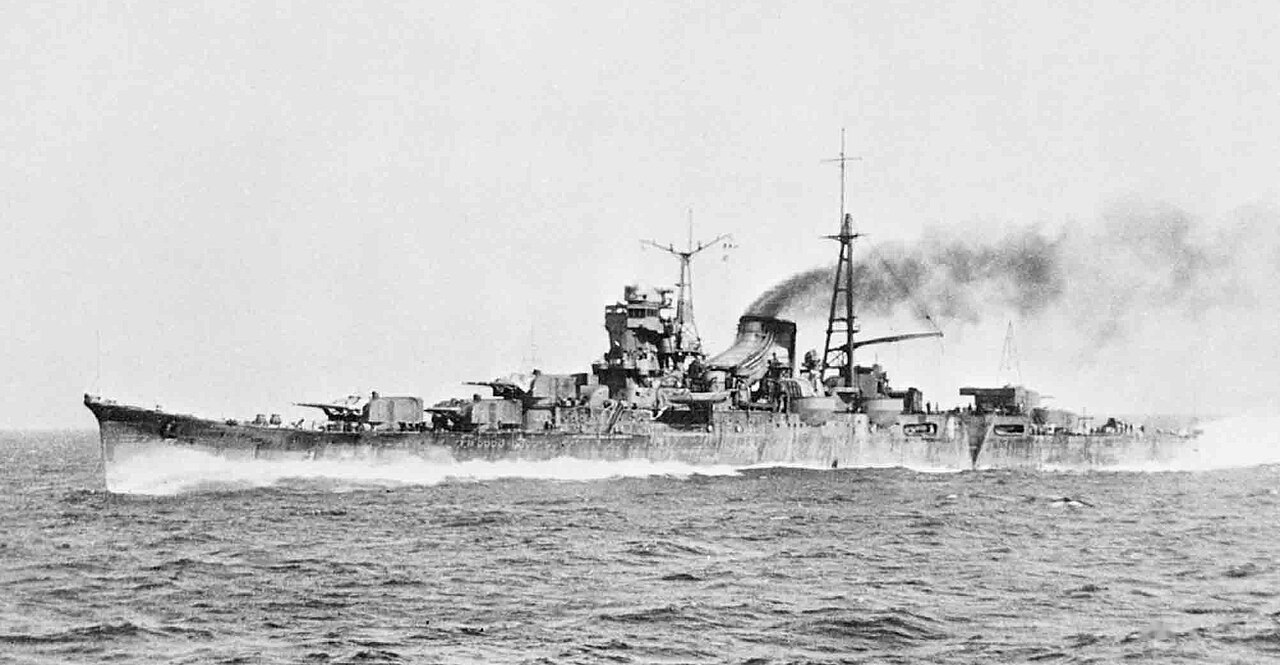
IJN Mogami (最上) was the lead ship of Japan’s most ambitious treaty cruisers, and the one that seemed to carry every misfortune the Imperial Navy could invent. Named for the Mogami River in Yamagata, she was laid down at Kure on 27 October 1931, launched 14 March 1934, and commissioned 28 July 1935. On paper she was a light cruiser: five triple 155 mm turrets, 37 knots, a hull welded light enough to stay under the London Treaty limit. In fact the barbettes were sized for 8-inch twins from the start. She was a heavy cruiser waiting for a diplomatic loophole.
The loophole opened. The welds did not.
On trials the hull flexed. In the Fourth Fleet Incident of September 1935 a typhoon crumpled her bow and warped the structure so badly the turrets would not train. She was disarmed, rebuilt, given bulges, and later rearmed with ten 203 mm guns. The class became among the fastest, heaviest-armed cruisers afloat. The reputation that followed her was already forming: beautiful, overstrained, and unlucky.
When war came she covered the landings in Malaya, Sarawak, and Java with Cruiser Division 7: Mikuma, Suzuya, and Kumano. On the night of 28 February–1 March 1942, in Sunda Strait, she and Mikuma helped finish USS Houston and HMAS Perth. That sinking is not credited to one Japanese ship. Then her Long Lances, fired into the dark at the Allied cruisers, ran on into the Japanese transport anchorage. Five friendly ships were hit: the army landing ship carrying Lieutenant General Hitoshi Imamura, who spent twenty minutes in the water, three other transports including a hospital ship, and minesweeper W-2. Imamura’s staff later asked that he not be told. Let him believe Houston had done it.
Midway was worse.
On the night of 5 June 1942, after the bombardment dash was cancelled, Cruiser Division 7 sighted the submarine Tambor. Kumano ordered a simultaneous 45-degree turn to port. Mikuma turned 90. Mogami, last in line, turned as ordered and drove her bow into her sister’s port side just aft of the bridge. Forty feet of Mogami’s forecastle folded almost 90 degrees to port. Mikuma’s fuel tanks ruptured and left a shining trail across the sea. Captain Sakiyama of Mikuma stayed with the crippled pair instead of running. The next morning aircraft from Enterprise and Hornet followed the oil. Mikuma’s remaining torpedoes cooked off. She burned and sank. American carrier aircraft are credited with that sinking, not one ship. Lieutenant Commander Masayoshi Saruwatari had already jettisoned Mogami’s torpedoes. That decision, made while the bow was still a wreck, is why she lived. Six bombs still found her. No. 5 turret was wiped out, the sickbay burned, and the hull was holed over and over. Some 80 to 90 men were dead. She crawled home.
The navy did not scrap her. From August 1942 to April 1943 at Sasebo they cut away the after turrets and built a flight deck for eleven floatplanes. She became an aircraft cruiser, a scout for a fleet that was already running out of eyes. Luck did not improve. In May 1943 she collided with the oiler Toa Maru in Tokyo Bay. In June she was moored near Mutsu when the battleship exploded. Her boats found no one. In November, at Rabaul, a 500-pound bomb from Saratoga set her on fire and killed nineteen. She was patched, given more 25 mm guns, and sent south again.
By Leyte she was a veteran of collisions, friendly fire, reconstruction, and survival. On 22 October 1944 she left Brunei with Vice Admiral Shoji Nishimura’s Force C: the old battleships Fuso and Yamashiro, and four destroyers. Their task was to force Surigao Strait and meet Kurita in Leyte Gulf. They were sailing into a prepared ambush of PT boats, destroyers, cruisers, and six battleships, several of them raised from Pearl Harbor.
Before dawn on 25 October a 6-inch dud from Fuso killed three men in Mogami’s sickbay. Then American destroyers and the battle line opened. Four 8-inch shells from Portland wrecked the bridge and the air-defense center. Captain Ryo Toma and the executive officer died where they stood. The chief gunnery officer took command. Mogami turned south, still firing, and launched torpedoes that passed close to American ships but hit nothing.
In the smoke she met Vice Admiral Kiyohide Shima’s column coming the other way. Nachi’s captain thought Mogami was dead in the water. She was not. At about 0423 the two cruisers collided. Fires reached Mogami’s remaining Long Lances. They exploded and killed the starboard engine. American cruisers, Portland, Louisville, and Denver, poured in more shells. After sunrise Avengers from the escort carriers hit her with 500-pound bombs. Aviation gasoline went up. The last turbine stopped.
At 1047 the crew went over the side. She burned and drifted for two more hours. At 1256 the destroyer Akebono put one Type 93 torpedo into her port side. At 1307, at roughly 09°40′N, 124°50′E, Mogami went down by the bow. About 191 or 192 men and one civilian worker went with her. Akebono took off some 700, including more than a hundred wounded. The collision with Nachi sent that cruiser into Manila, where American aircraft later sank her. Divers recovered Admiral Shima’s flag, the only enemy admiral’s flag taken from a warship at sea in the war. Even Mogami’s last accident outlived her.
She was stricken on 20 December 1944. In May 2019 the research ship Petrel found the wreck in 1,450 meters of water. The hull still shows the crushed bow of Midway, the scorch of Surigao, and the hole of Akebono’s torpedo.
Mogami was never a lucky ship. She was a hard one. She sank more of her own side than most submarines managed, rammed two fleet cruisers, took a typhoon, a bomb through the sickbay, a bridge wiped clean of officers, and her own oxygen torpedoes exploding in the hull, and still had to be scuttled because she would not sink on her own. A treaty compromise that became a fighting ship, a crew that kept her alive long after the design and the war had both failed her, and a name that, in Japanese naval memory, still means misfortune worn to the last knot.