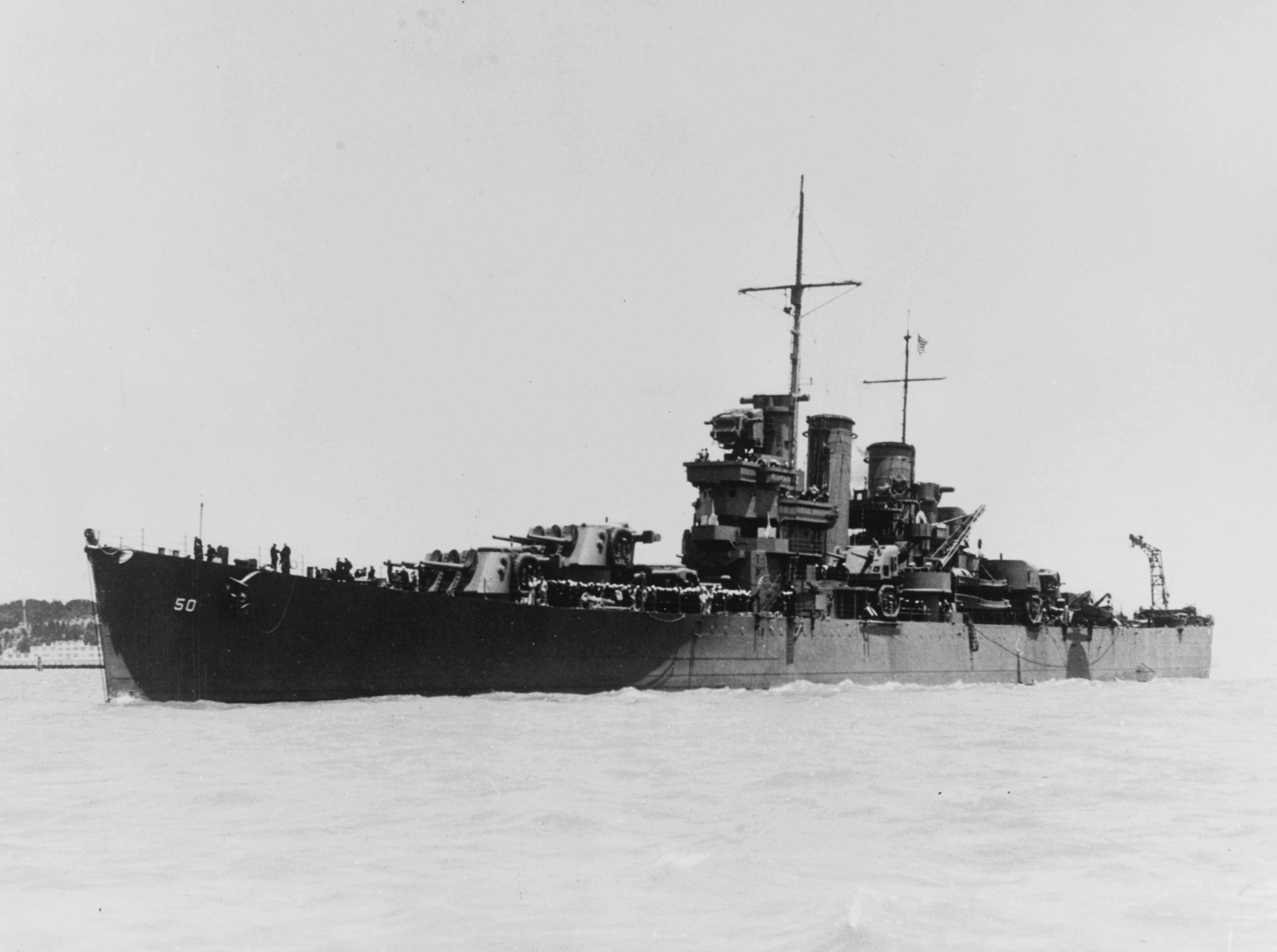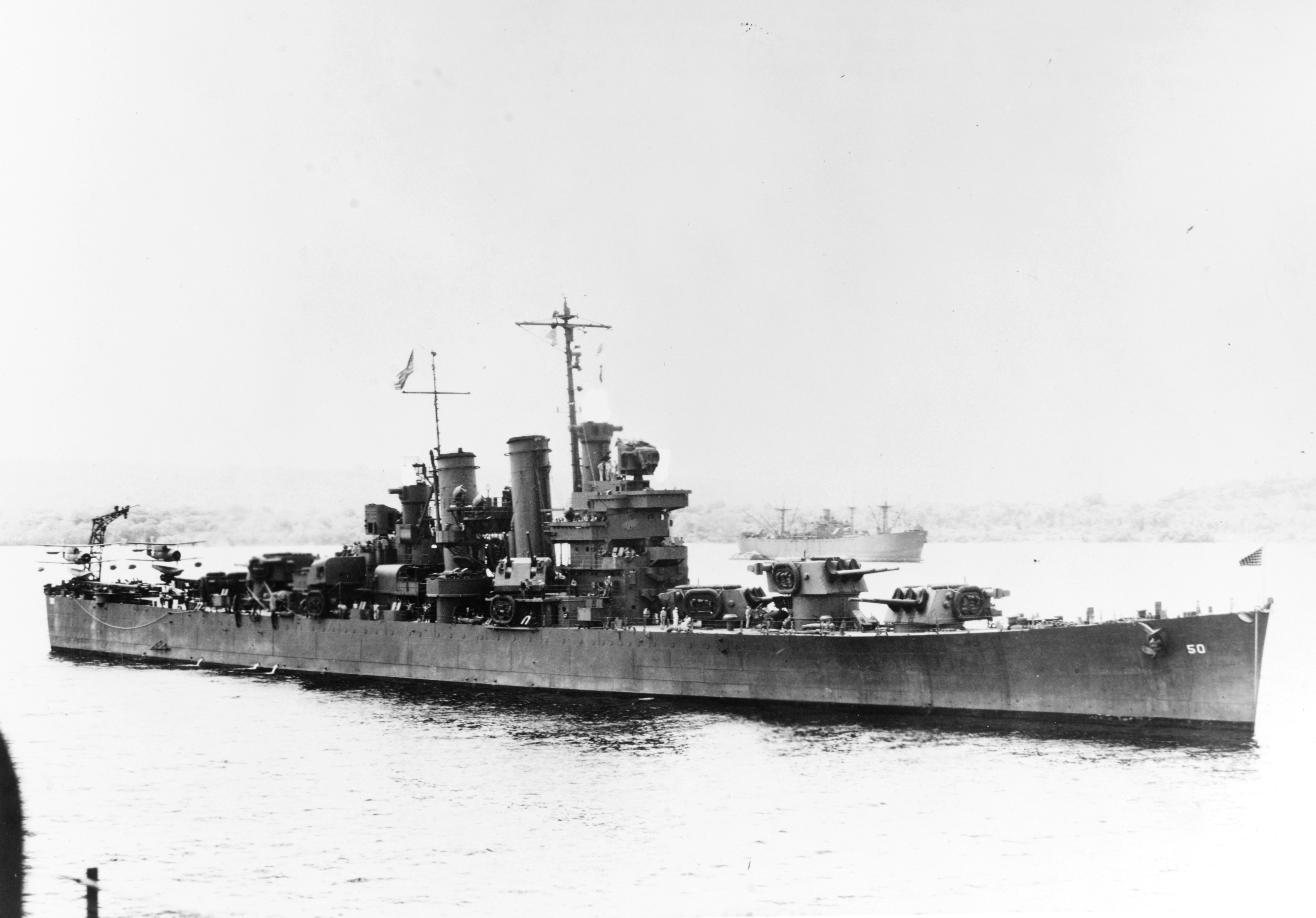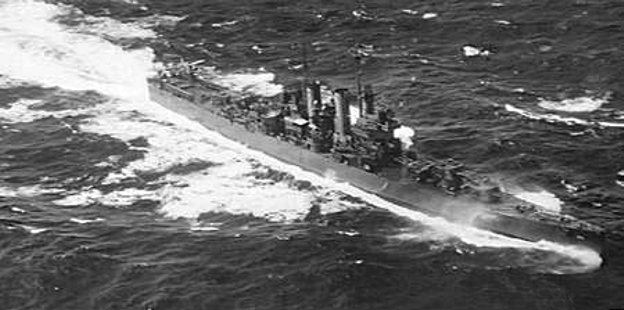
Helena was named for the city in Montana. This is the light cruiser CL-50. The New York Navy Yard laid her down on 9 December 1936, launched her on 27 August 1938, and commissioned her on 18 September 1939, Captain Max B. Demott in command. She and St. Louis were the improved Brooklyns: fifteen 6-inch guns in five triple turrets, and boiler rooms and engine rooms set in an alternating line so that one hit would not take all the steam at once.
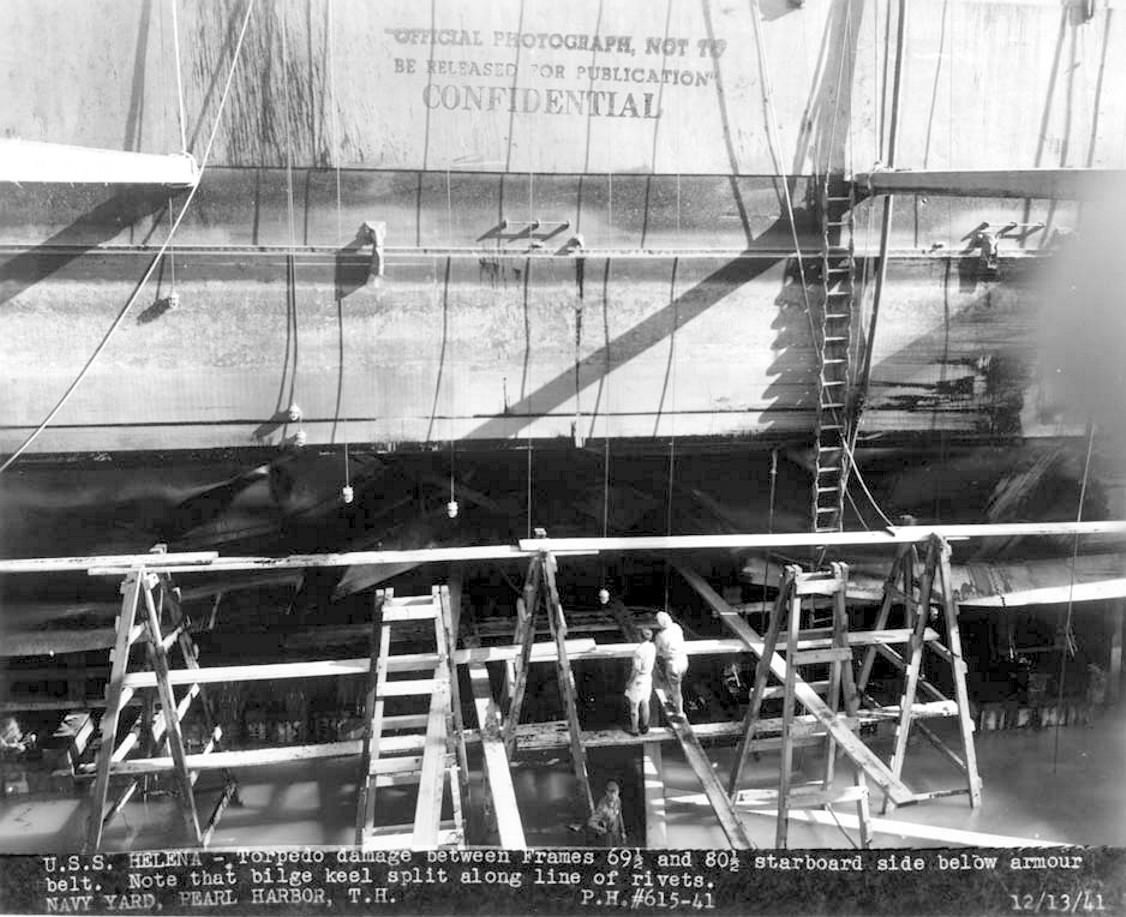
On 7 December 1941 she was moored at 1010 Dock at Pearl Harbor, in the berth usually kept for the battleship Pennsylvania. The minelayer Oglala lay outboard of her. A torpedo passed under Oglala and hit Helena on the starboard side, almost amidships. One engine room and one boiler room flooded. Men were killed. She stayed afloat. Repairs began at Pearl Harbor and were finished at Mare Island.
In the summer of 1942 she went south into the Guadalcanal campaign. On 15 September she was with the force covering Marine reinforcements when Japanese submarine I-19 torpedoed the carrier Wasp. Helena took nearly 400 of Wasp’s men aboard and carried them to Espiritu Santo.
On the night of 11–12 October 1942 she fought at Cape Esperance. Equipped with the better radar, she made the first contact and opened fire at 2346. When the shooting stopped in Iron Bottom Sound, Japanese heavy cruiser Furutaka and destroyer Fubuki were gone and another Japanese cruiser was badly hurt. Her 6-inch battery had been in that fire from the first salvo.
On the night of 12–13 November she steamed in Rear Admiral Daniel Callaghan’s column off Guadalcanal, between Portland and Juneau, to stop a Japanese bombardment force that included two fast battleships. The lines ran together in the dark. She took minor damage. One man was killed. Her radar had the enemy first. At about 0204 her 6-inch guns hit the destroyer Amatsukaze. Tameichi Hara, Amatsukaze’s captain, later named the cruiser as Helena. The hits knocked out Amatsukaze’s guns and steering. Hara conned her by hand for hundreds of miles and made Truk. Asagumo, Murasame, and Samidare then drew Helena’s fire. By morning the Japanese bombardment of Henderson Field had been broken. Battleship Hiei, crippled in the melee, was finished off the next day.
In January 1943 she twice shelled Japanese bases on New Georgia and Kolombangara. After overhaul at Sydney she was back at Espiritu Santo in March and went on bombarding New Georgia through the spring and early summer as the next island in the slot was prepared for landing.
On the night of 4–5 July 1943 she stood into Kula Gulf with the ships covering the landing at Rice Anchorage and fired on the shore—her last bombardment. Before dawn on 6 July she was in Rear Admiral Ainsworth’s cruiser line: Honolulu, Helena, and St. Louis. Nicholas and O’Bannon were ahead; Jenkins and Radford astern. They met a Japanese destroyer force running the Tokyo Express. American guns sank the Japanese flagship Niizuki. Rear Admiral Akiyama Teruhisa went down with her.
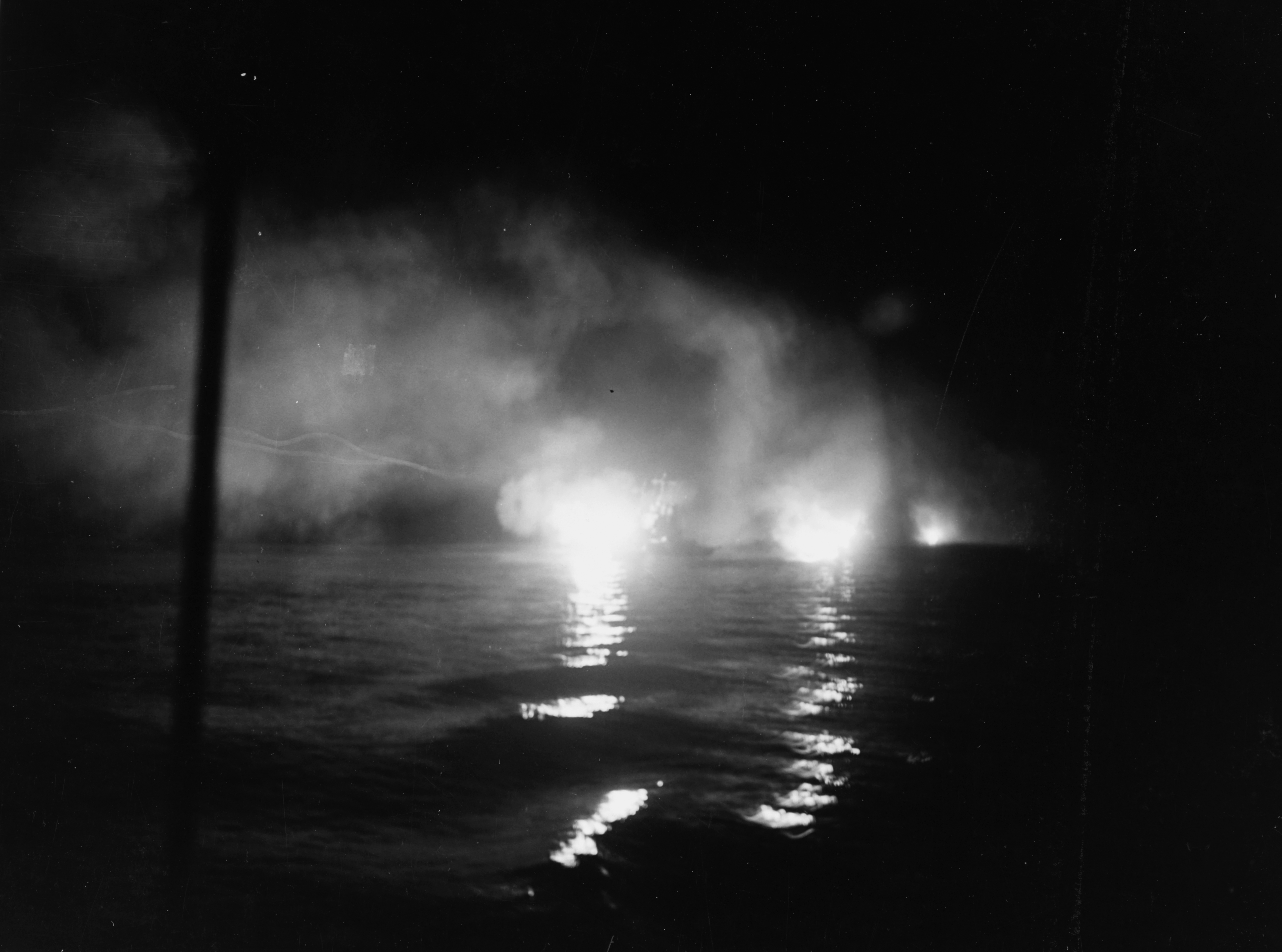
Helena’s own gun flashes lit her up. Destroyers Suzukaze and Tanikaze launched Type 93 torpedoes. Three hit her on the port side. The first, at about 0203, tore the bow off below Turret I. Two more followed at 0205. She broke into three pieces. The main hull went under at about 0225. The bow sank the next day. Captain Charles P. Cecil had the ship. He survived.
Nicholas and Radford stayed in the water and took men off. They broke off the rescue three times to fight. Nicholas took 291 aboard. Together the two destroyers got more than 700 off. Another group of survivors reached Vella Lavella and was brought out on the night of 16 July—165 Helena men and 16 Chinese who had been hiding on the island. Of nearly 900 men, 168 were dead.
She was the first ship awarded the Navy Unit Commendation. The citation named Cape Esperance, the night action of 13 November, and Kula Gulf. She also received seven stars on the Asiatic-Pacific campaign medal. The wreck of the light cruiser that opened fire first at Cape Esperance still lies in Kula Gulf.