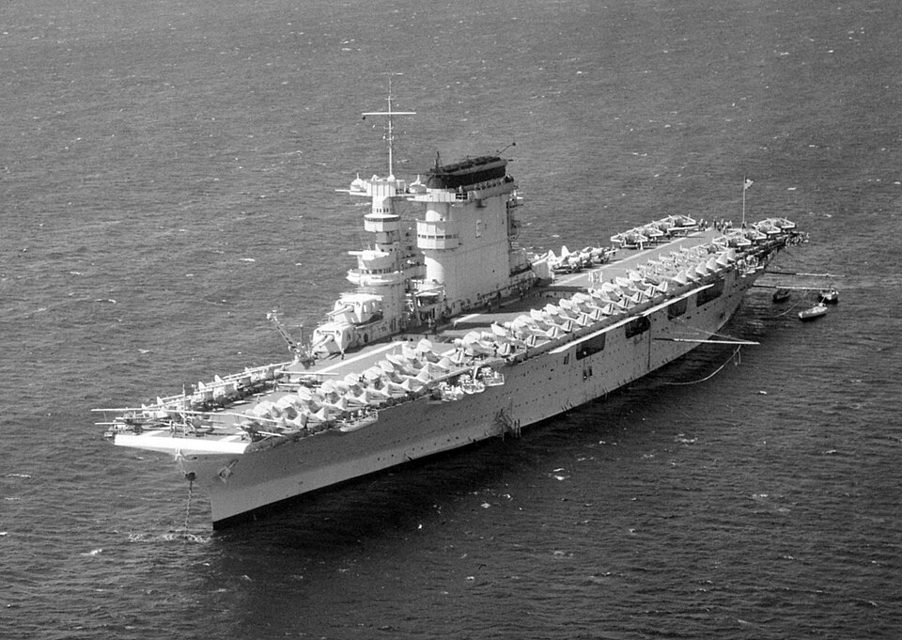
From battlecruiser to carrier
Lexington was the fourth Navy ship named for the 1775 battle that opened the Revolutionary War. She was authorized in 1916 as the battlecruiser CC-1, but her building was put off so that the escorts and merchant ships needed against the U-boats could be built first. Fore River Shipbuilding at Quincy, Massachusetts, finally laid her down on 8 January 1921. In February 1922, with the Washington Naval Conference still sitting, work stopped when she was 24.2 percent complete. On 1 July 1922 she was reauthorized as an aircraft carrier. Her hull lines and torpedo protection were already built and were kept. Removing her eight 16-inch guns saved 4,000 tons. She was christened by Helen Rebecca Roosevelt, wife of Assistant Secretary of the Navy Theodore Douglas Robinson, and launched on 3 October 1925. She was commissioned on 14 December 1927, Captain Albert Marshall in command. Her turbo-electric plant drove her at 34.59 knots on trials in 1928, against a designed 33.25. Her hangar was said to be "the largest single enclosed space afloat on any ship."
"Lady Lex" between the wars
Based at San Pedro until 1940, she and her sister Saratoga worked out American carrier doctrine in the Fleet Problems. In Fleet Problem IX in January 1929, Saratoga's planes "attacked" the Panama Canal while Lexington tried and failed to defend it. In Fleet Problem XI Saratoga knocked out her flight deck for 24 hours. From December 1929 to January 1930, when drought had drained the reservoir behind Tacoma's hydroelectric dam, her generators were wired into the city's grid and kept the lights on. On 31 March 1931, off Guantánamo, she was ordered to help after the Managua earthquake, and the next day her planes flew doctors and supplies into the city. In Fleet Problem XVI in 1935 she ran low on fuel after five days at high speed, which led to the experiments in underway refueling that later became essential. Her planes and Saratoga's twice staged successful dawn "attacks" on Pearl Harbor, the second on 29 March 1938. In 1939 she joined Ranger, Yorktown and Enterprise for Fleet Problem XX, the only time before October 1943 that four carriers maneuvered together.
The first months of war
On 7 December 1941 she was at sea under Rear Admiral John Newton, ferrying aircraft to Midway. The ferry mission was cancelled and she joined Vice Admiral Wilson Brown's ships to search for the Japanese. She was then sent to raid the Marshalls as a diversion for the Wake relief force, but Wake fell first. A January raid on Wake was cancelled when I-72 sank the oiler Neches. On 20 February 1942, 453 miles northeast of Rabaul, a flying boat spotted her, and seventeen G4M "Betty" bombers of the 4th Kōkūtai attacked. Captain Frederick Sherman's deck crews cleared fifteen fully fueled planes off the flight deck just in time. Commander Herbert Duckworth remembered "as if some great hand moved all the planes aft simultaneously." Her Wildcats shot down most of the attackers. Lieutenant Edward "Butch" O'Hare won the Medal of Honor for breaking up one wave single-handed. On 10 March she and Yorktown flew over the Owen Stanley Range to strike the Japanese invasion shipping at Lae and Salamaua.
The Coral Sea
After a quick refit at Pearl Harbor she rejoined Yorktown in the Coral Sea to stop the Japanese invasion of Port Moresby. On 7 May 1942 her VB-2 Dauntlesses hit the light carrier Shōhō twice at 11:18, her VT-2 torpedo planes followed, and Yorktown's planes finished the carrier off at 11:31. It was the first Japanese carrier sunk in the war. On 8 May the two fleets struck each other. American planes badly damaged Shōkaku. Around 11:20 Japanese torpedo planes hit Lexington twice to port. The correspondent Stanley Johnston, on her signal bridge, counted five hits. The first jammed her elevators and cracked her port gasoline tanks, and the second flooded three firerooms. Bombs hit her funnel and near-missed alongside. She corrected her list and began recovering aircraft at 11:39.
At 12:47 sparks set off gasoline vapor from the cracked tanks. The explosion killed 25 men and wrecked central damage control, yet she kept flying planes off and on until 14:14. Further explosions at 14:42 and 15:25 started hangar fires, cut power forward, and took away water pressure. By 16:00 every compartment below the waterline had been abandoned and she lay dead in the water. Sherman ordered "abandon ship" at 17:07. Explosions from about 18:00 blew her after elevator apart, and Sherman left only at 18:30 after making sure his men were off. The destroyer Phelps fired five torpedoes into her between 19:15 and 19:52, and she sank at 15°20′S 155°30′E with 42 aircraft. About 216 of her crew were killed.
The wreck
On 4 March 2018 Paul Allen's research vessel Petrel found her wreck about 3,000 meters down, more than 800 kilometers off the Australian coast. Her nameplate on the stern confirmed her identity.
Sources
Wikipedia, "USS Lexington (CV-2)" (citing Lundstrom, The First Team; Johnston, Queen of the Flat-Tops; Stern; Nofi on the Fleet Problems).
NHHC/DANFS, "Lexington IV"; NHHC, "Loss of USS Lexington."