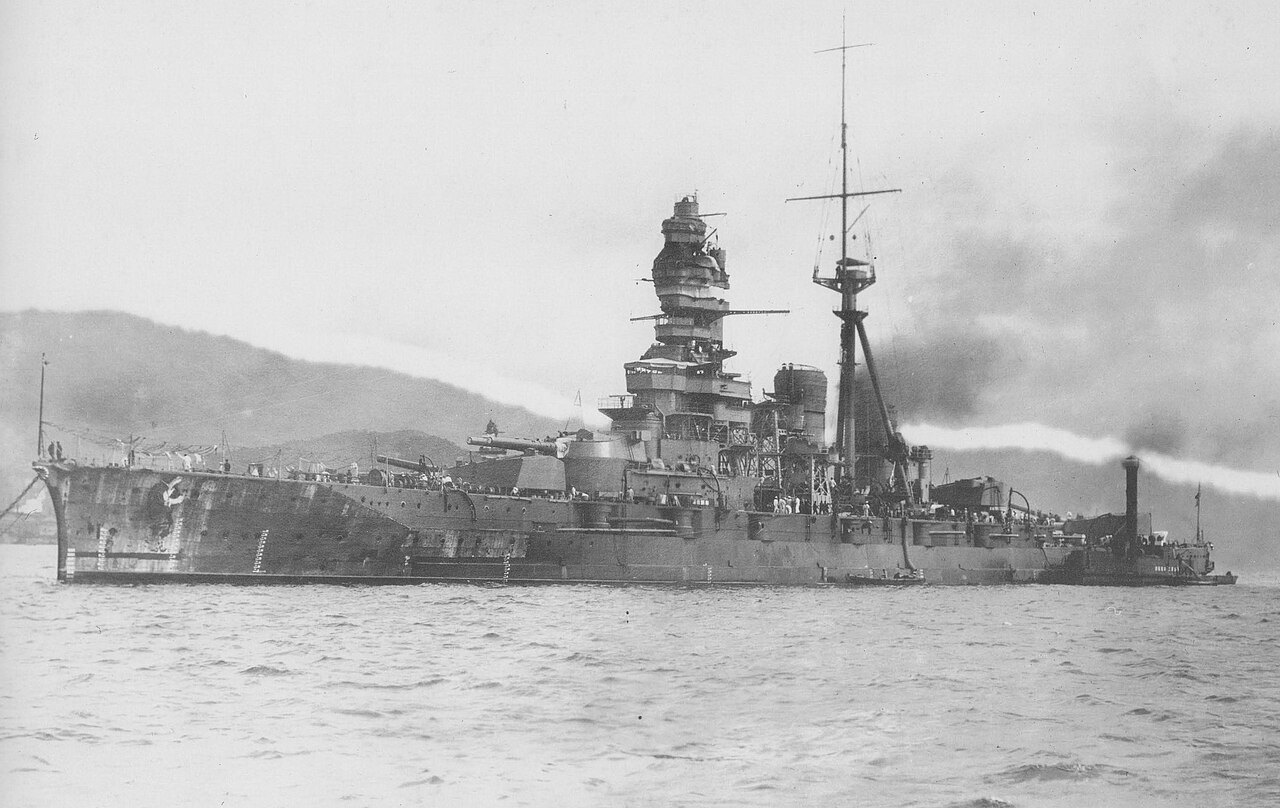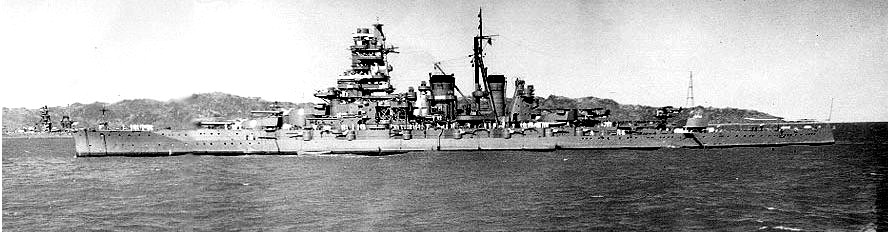
IJN Kirishima (霧島) was named for the volcano on Kyushu. Mitsubishi laid her down at Nagasaki on 17 March 1912, launched her on 1 December 1913, and the Navy commissioned her on 19 April 1915. She was a Kongo-class battlecruiser, drawn by the British designer George Thurston along the lines of the Lion class, and she was one of the first Japanese capital ships built in a private yard. Kongo had been built in Britain. Hiei came from a navy yard. Kirishima and Haruna did not.
She was finished with eight 14-inch guns and the thin armor of a battlecruiser. In the 1930s the class was rebuilt. The hulls were lengthened, the machinery replaced, and the four ships came out as fast battleships, able to run with the carriers. The speed was the point. The armor was never what a new battleship carried.
On 1 March 1942 she was with Hiei, Tone, and Chikuma, about 200 miles south-southeast of Christmas Island. The destroyer Edsall was alone. Lieutenant Joshua J. Nix had just put survivors from the seaplane tender Langley aboard the oiler Pecos, and he was heading back toward Java. Chikuma opened the gun action. The four ships fired more than 1,300 shells. Only one or two hits are credited before the aircraft arrived. One of Edsall's torpedoes narrowly missed Chikuma. Dive bombers stopped her: eight from Kaga, nine from Hiryu, and nine from Soryu. She went down by the stern. That gunfire did not by itself sink Edsall. The sinking is not pinned to Kirishima. Chikuma picked up a handful of survivors. A cameraman on Tone filmed the last of it.
At Midway she screened the carriers, with Haruna. She was not sunk.
On 13 November 1942 she was in Rear Admiral Hiroaki Abe's night action off Guadalcanal, with Hiei. Rear Admiral Daniel J. Callaghan's column and Abe's ran together in the dark near Savo Island. Kirishima took one hit. The ship that hit her is not known. She was not sunk that night. Hiei was disabled and sunk later the same day. That sinking is not credited to Kirishima.
Two nights later Vice Admiral Nobutake Kondo came to shell Henderson Field. His flag was in Atago. Kirishima was with Atago and Takao. Rear Admiral Willis A. Lee was already there, his own flag in Washington, South Dakota astern of her, and four destroyers ahead: Walke, Benham, Preston, and Gwin. The Japanese cruisers and destroyers sank Walke and Preston, wrecked Benham, and damaged Gwin. Those losses are not credited to one ship.
Kirishima hit South Dakota with 14-inch shells. Atago, Takao, Nagara, and Sendai hit South Dakota as well. A power failure had left the American battleship nearly blind. She took more than two dozen shells. She was not sunk. She did not sink Kirishima.
Washington had not been seen while those ships fired at South Dakota. She opened with 16-inch guns at about 8,400 yards, and her 5-inch battery fired with them. The gunfire wrecked Kirishima. Steering went. Turrets went. Steam drove the men out of the machinery spaces. Captain Sanji Iwabuchi ordered the crew off. Teruzuki, Asagumo, and Samidare came alongside and took the survivors. About 210 of her men were lost. At 03:25 on 15 November 1942, off Savo Island, she capsized.
Washington was not hit. South Dakota was in the fight. South Dakota did not sink her.