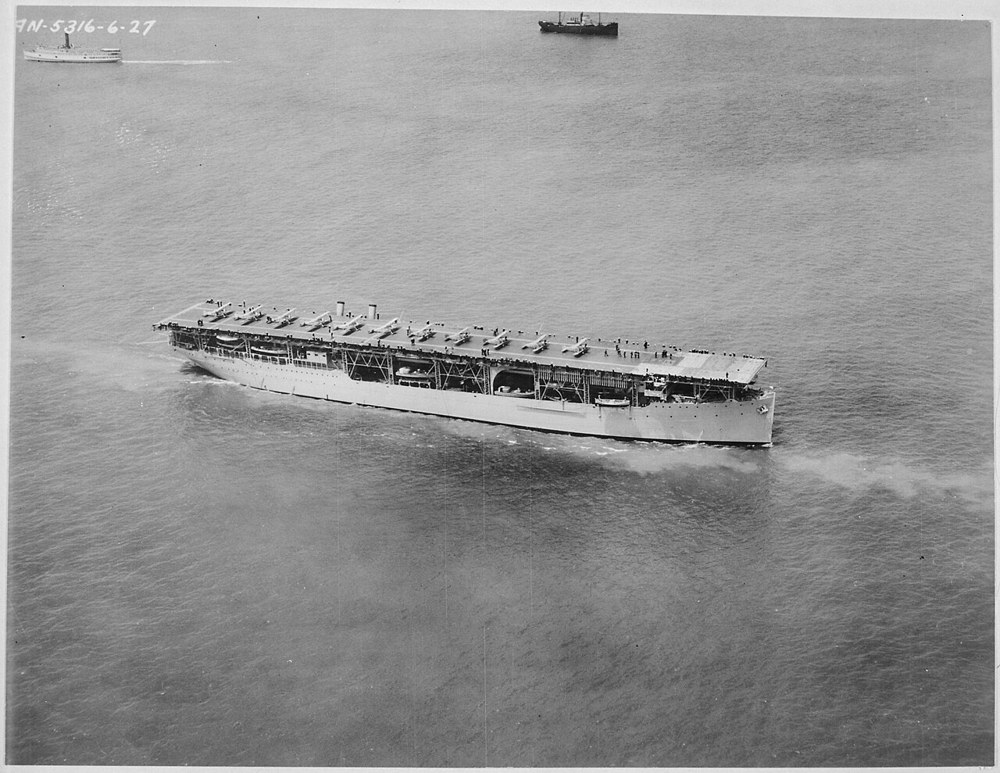
USS Langley (CV-1) was the first aircraft carrier of the United States Navy. She was built as the collier Jupiter, laid down on 18 October 1911, launched on 24 August 1912 and commissioned on 7 April 1913 as the Navy's first turbine-electric ship. She was converted into a carrier from 1920, renamed Langley on 11 April 1920 for the aviation pioneer Samuel P. Langley, and recommissioned on 20 March 1922. The first plane launched from her deck was a Vought VE-7 on 17 October 1922. She trained the first carrier pilots for the larger carriers Lexington and Saratoga.
In 1936 and 1937 she was converted to a seaplane tender and became AV-3. When Japan attacked in December 1941 she was at Cavite and went south to Balikpapan, then to Darwin. She was part of the Allied command in the Dutch East Indies. At Fremantle she loaded 32 P-40 fighters, 33 Army pilots and some ground crew of the 13th Pursuit Squadron (Provisional). She was sent to Tjilatjap on Java without a proper escort. She is not the later light carrier Langley (CVL-27).
On the morning of 27 February 1942 she met the destroyers Whipple and Edsall, which had come out to escort her. At about 1140, 75 miles south of Tjilatjap, sixteen Japanese Mitsubishi G4M bombers attacked. She was hit by five bombs and 16 of her crew were killed. She lost steering, flooded and took on a 10-degree list, and the order to abandon ship was passed at 1332. Whipple and Edsall took off the survivors and sank her with gunfire and torpedoes. The survivors were transferred to the oiler Pecos, which Japanese carrier aircraft sank. Many of the Langley men were lost with her. Edsall was sunk the same day by Japanese warships. She earned two battle stars.
Her commanding officer in February 1942 was Commander McConnell, from the account above.
Sources: Dictionary of American Naval Fighting Ships (DANFS), Wikipedia, NavSource Online (commanding officers) and Wikimedia Commons (photograph records).